 EN
EN  ES
ES  IT
IT  FR
FR 
If you are running a solo or small coaching practice, you have probably hit the same wall: there are only so many hours in the week, and every new client adds another resume to review, another cover letter to critique, another round of mock interview questions to write. Hiring a junior coach feels premature. Raising prices helps, but only so far. The bottleneck is not your expertise. It is the volume of repetitive, execution-level work that fills your calendar before the high-value conversations even begin.
An AI career platform for career coaches is the most practical answer to that problem. Not because AI replaces what you do, but because it handles the grunt work so you can focus on what clients are actually paying for: strategic clarity, accountability, and the kind of nuanced guidance that no algorithm can replicate.
This guide walks through exactly how it works, what to look for in a platform, and how to structure your practice so AI does the heavy lifting between sessions while you stay firmly in the driver’s seat.
Why Career Coaches Hit a Capacity Ceiling (And Why Hiring Is Not the Only Answer)
The economics of a coaching practice are straightforward until they are not. You charge per session or per package. Revenue grows as your roster grows. But at some point, adding one more client means working evenings, and adding five more means burning out or hiring someone you may not yet have the revenue to support.
The root cause is almost always the same: too much of a coach’s time goes toward execution tasks rather than advisory tasks. Consider a typical client engagement. Before each session, a coach might spend 30 to 45 minutes reviewing the client’s latest resume version, checking it against a new job posting, and preparing targeted feedback. After the session, there are follow-up notes, resource recommendations, and sometimes a draft cover letter to review. Multiply that by 20 active clients and you have a part-time job that exists entirely outside the sessions you are actually billing for.
Hiring a part-time assistant can help with scheduling and admin. But it does not solve the core problem: the substantive, job-search-specific work (resume analysis, keyword matching, ATS compatibility checks, interview question banks) still requires someone with expertise, and that someone is usually you.
AI career coaching software changes the equation by automating exactly those tasks. The AI does not replace your judgment. It does the preparation work so that when you sit down with a client, you are already looking at an analyzed resume, a gap report, and a set of tailored recommendations. Your session time goes toward interpretation, motivation, and strategy rather than line-by-line edits.
What an AI Career Platform Actually Does for a Coaching Practice
The term “AI platform” gets used loosely, so it is worth being specific about the capabilities that genuinely move the needle for coaches who want to scale their career coaching business.
ATS Resume Scoring and Gap Analysis
An Applicant Tracking System (ATS) is the software most employers use to filter resumes before a human ever reads them. A strong AI platform includes an ATS resume checker that scores a client’s resume against a specific job description, flags missing keywords, and identifies formatting issues that cause parsing failures. Rather than you doing this manually, the client runs the check themselves before your session. You review the output together and focus on the strategic decisions, not the diagnostic work.
JobWinner’s ATS Resume Checker does exactly this, and it is the kind of tool that transforms a 45-minute pre-session prep into a 5-minute review.
AI Resume Tailoring
Tailoring a resume for each job application is the single task that consumes the most client time and, by extension, the most coaching time. An AI resume tailoring engine reads the job description, identifies the skills and experience the employer is prioritizing, and suggests targeted edits to the client’s existing resume. The client makes the final call on every change. The AI just surfaces the options and explains the reasoning.
Cover Letter Generation
Cover letters are high-effort, low-differentiation for most clients. They know roughly what to say, but the blank page stops them. An AI cover letter generator drafts a tailored letter based on the job description and the client’s resume, which the client then personalizes with their own voice and specific examples. Coaches who used to spend 20 minutes per client reviewing a cover letter draft can now spend 5 minutes reviewing a client-edited AI draft that is already structurally sound.
Interview Preparation at Scale
Behavioral interview prep is one of the most valuable things a coach can offer, and also one of the most time-intensive to deliver consistently. An AI interview preparation tool generates role-specific question banks, coaches clients through STAR-method responses, and provides feedback on answer structure. Clients can practice between sessions without waiting for their next booking. You review their progress, add nuance, and focus on the questions they are genuinely struggling with.
Job Tracking and Progress Visibility
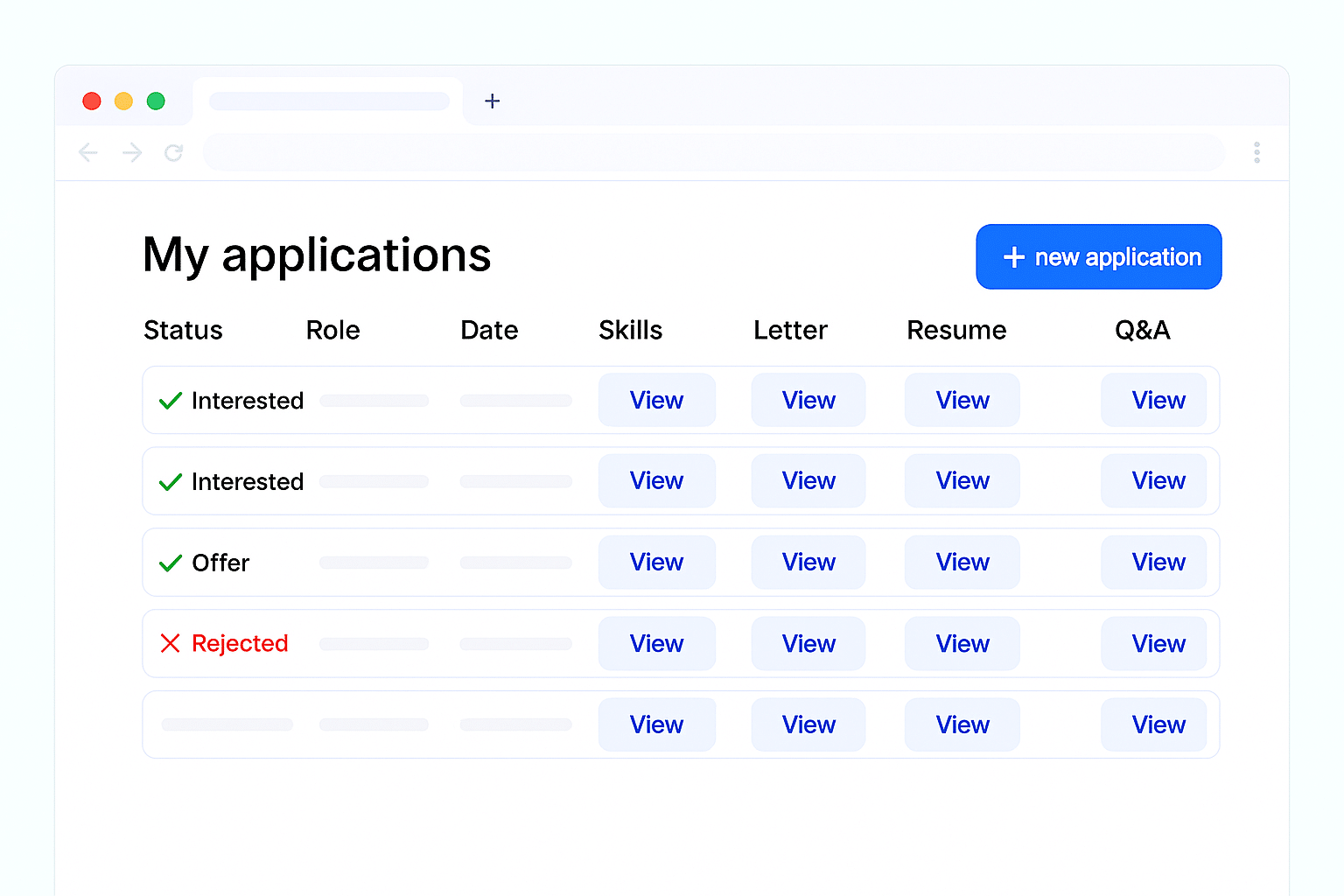
A centralized job tracker gives both the coach and the client a shared view of where each application stands: which roles have been applied to, which are in progress, which have moved to interview stage. Instead of spending the first ten minutes of every session asking “so where are we?”, you walk in already knowing. That time goes back to the conversation that actually moves the client forward.
How a White-Label AI Career Platform Works for Coaches
A white-label AI career platform lets you license an existing AI tool and present it to clients under your own brand. Your clients log in to a platform that carries your name and logo. They use AI-powered tools that you have configured for your service model. The underlying technology is maintained by the platform provider. You focus on your clients.
The practical setup looks like this:
- You license the platform from a provider like JobWinner and configure the branding (logo, colors, domain).
- You define the client experience by choosing which tools to activate: resume builder, ATS checker, cover letter generator, interview prep, job tracker.
- You invite clients to the platform as part of your onboarding process. It becomes a standard part of your engagement, not an optional add-on.
- Clients use the tools between sessions, generating data and drafts that you both review together.
- You monitor progress from a coach dashboard, seeing which clients are active, which are stuck, and where to focus your session time.
The white-label model matters for two reasons. First, it protects your brand. Clients are paying for your expertise and methodology, not for a generic AI tool. The platform should feel like a natural extension of your practice. Second, it gives you a defensible competitive advantage. A solo coach who offers a structured, AI-powered client experience competes very differently from one who offers sessions alone.
Insider Tip: The coaches I have seen scale most effectively with AI are not the ones who automate the most. They are the ones who are clearest about what only they can provide, and ruthless about delegating everything else to the platform. Your value is in the interpretation, the accountability, and the human read of a client’s situation. Let the AI handle the rest.
The Capacity Math: What AI Actually Unlocks
Let’s put some rough numbers to the opportunity, because the case for career coaching software is ultimately a time and revenue argument.
A typical solo career coach with 15 to 20 active clients spends, conservatively, 2 to 3 hours per client per week on non-session work: resume reviews, cover letter feedback, interview prep materials, and progress check-ins. That is 30 to 60 hours per week of execution work on top of the sessions themselves.
An AI career platform does not eliminate that work. But it shifts the ratio dramatically. Clients do the first pass themselves using AI tools. The coach reviews outputs rather than producing them from scratch. The realistic time saving is 60 to 75 percent of that non-session work, which translates to 18 to 45 hours per week recovered.
Those hours can go in one of three directions:
- More clients. If each client previously required 3 hours of non-session work and that drops to 45 minutes, you can serve roughly four times as many clients in the same total time.
- Group programs. AI platforms make group coaching viable because the individualized tool experience replaces some of the 1:1 attention. You can run a cohort of 15 clients through a structured job search program with AI doing the personalization work at scale.
- Deeper work with fewer clients. Some coaches prefer to keep their roster size and use the recovered time to go deeper: more session time, better preparation, stronger outcomes. That shows up in testimonials, referrals, and premium pricing.
| Approach | Without AI Platform | With AI Platform |
|---|---|---|
| Active clients (solo coach) | 15 to 20 | 40 to 60 |
| Non-session hours per client/week | 2 to 3 hours | 30 to 45 minutes |
| Group program viability | Difficult without staff | Practical with AI self-serve layer |
| Client progress visibility | Self-reported in sessions | Dashboard view before each session |
| Resume tailoring per application | Coach-driven, 20 to 40 min | Client-driven with AI, 5 to 10 min review |
| Interview prep delivery | Session-only or async email | AI simulator available 24/7 |
How to Choose the Right AI Career Platform for Your Coaching Practice
Not every platform is built for coaches. Some are built for individual job seekers and have no multi-client management layer. Others are enterprise tools that require IT integration and multi-month onboarding. Here is what to look for when evaluating ai tools for career coaches specifically.
White-Label and Branding Controls
The platform should be configurable to your brand without requiring a developer. At minimum: your logo, your color scheme, and a subdomain or custom domain. Clients should not see the underlying provider’s branding unless you choose to disclose it.
Coach Dashboard and Client Management
You need a view across all clients, not just within each client’s individual account. Look for a dashboard that shows client activity, resume scores, application volume, and interview prep progress. This is what makes the “review before the session” workflow actually work.
Core Tool Coverage
The platform should cover the full job search workflow: resume building and tailoring, ATS scoring, cover letter generation, interview preparation, and job tracking. Gaps in coverage mean clients still come to you for those tasks, which defeats the purpose.
Client Onboarding Experience
If the platform is confusing for clients to set up, they will not use it between sessions, and you will not recover the time you were hoping to. Look for a clean, guided onboarding flow that a non-technical client can navigate independently.
Pricing Model That Works at Scale
Per-seat pricing that scales linearly with clients can erode your margins as you grow. Look for a model that gives you a reasonable cost per client at the volume you are targeting, with room to expand without a pricing cliff.
Insider Tip: Ask any platform vendor for a demo with a real client scenario, not a pre-built walkthrough. Have them show you what a client sees when they paste in a job description and run an ATS check on their resume. The quality of that output is the quality of the tool.
JobWinner’s career platform for career coaches is built specifically for this use case, with white-label controls, a multi-client dashboard, and the full suite of job search tools under one roof. If you want to see it in context, the case studies page includes real examples from coaching practices that have used it to grow.
How to Integrate an AI Platform Into Your Existing Coaching Model
Adding a new tool to an existing practice only works if it fits the workflow clients already expect. Here is a practical integration approach that does not require you to rebuild your methodology from scratch.
Step 1: Audit Where Your Time Actually Goes
Before choosing a platform, spend one week tracking how you use your non-session coaching hours. Most coaches find that resume review and cover letter feedback account for the majority. That is where AI delivers the fastest return. Interview prep and job tracking are secondary but still significant.
Step 2: Reframe the Platform as Part of Your Program, Not an Add-On
Clients adopt tools when they are presented as core to the engagement, not optional extras. Build platform access into your intake process. “As part of working together, you will have access to our AI-powered job search platform. Before each session, I will review your latest resume score and application activity so we can focus our time on what matters most.” That framing sets expectations and drives usage.
Step 3: Run a Pilot With Three to Five Clients
Before rolling out to your full roster, test with a small group. This surfaces the friction points in your specific workflow and gives you real feedback on what clients find useful versus confusing. Two to three weeks is enough to get meaningful signal.
Step 4: Create a Simple Between-Session Ritual
The most effective coaches using AI platforms give clients a clear between-session task: run the ATS check on the next three jobs you want to apply for, complete one mock interview session, and update your job tracker. When clients arrive at the next session having done this, the conversation is immediately more productive.
Step 5: Use the Data to Improve Your Outcomes Story
Platform data gives you something most coaches lack: quantifiable evidence of client progress. ATS score improvements, application volume, interview conversion rates. This is the material that powers testimonials, case studies, and referrals. It also gives you the data to justify premium pricing and to compete effectively against larger outplacement firms that have historically had an institutional advantage on this front.
If you are thinking about how independent coaches stack up against those larger players, the post on how independent career coaches can compete with large outplacement firms using AI goes deeper on that specific dynamic.
Common Mistakes Coaches Make When Adding AI to Their Practice
The technology is straightforward. The implementation mistakes are predictable. Here are the ones worth avoiding.
- Presenting AI as a replacement for sessions. Clients hire coaches for human judgment and accountability. If you position the platform as “you can do this yourself now,” you undermine your own value. Position it as “this handles the prep so our sessions go deeper.”
- Choosing a tool built for job seekers, not coaches. A consumer-facing AI resume tool has no multi-client dashboard, no white-label controls, and no way to monitor client activity. It is the wrong product for the use case, no matter how good the underlying AI is.
- Skipping the onboarding step. Sending clients a login link without a walkthrough produces low adoption. A 15-minute onboarding call or a short video walkthrough dramatically increases the percentage of clients who actually use the platform between sessions.
- Automating everything at once. Start with the highest-time-cost task (usually resume review) and get that working smoothly before adding interview prep, cover letters, and tracking. Incremental integration is more sustainable than a full switch overnight.
- Not reviewing client platform activity before sessions. The whole point of the dashboard is to arrive at sessions informed. If you are not looking at the data before each call, you are getting the cost of the platform without the time savings.
You can also use JobWinner’s AI Resume Tailoring tool directly with clients during sessions as a live demonstration of how keyword matching works, which tends to make the concept click much faster than explaining it abstractly.
Frequently Asked Questions
What is an AI career platform for career coaches?
An AI career platform for career coaches is a software suite that automates the repetitive, time-intensive parts of job search support: resume tailoring, ATS scoring, cover letter drafting, interview practice, and progress tracking. Coaches deliver these services through a branded interface, freeing their own time for high-value advisory work. Most platforms offer a white-label option so the tool appears under the coach’s own brand.
How does a white-label AI career platform work for coaches?
A white-label AI career platform lets a career coach license an existing AI tool and present it to clients under their own brand name and logo. The coach sets up the platform once, configures the client experience, and then invites clients to use it directly. The underlying AI handles resume analysis, keyword matching, cover letter generation, and interview prep, while the coach focuses on strategy and accountability sessions.
Can AI help a career coach manage more clients at once?
Yes. AI handles the between-session workload that normally limits how many clients a coach can take on: reviewing resumes, checking ATS compatibility, generating tailored cover letters, and running mock interview drills. When those tasks run on autopilot, a coach can realistically double or triple their active client roster without adding hours to their week.
What AI tools can career coaches use to serve more clients?
The most impactful AI tools for career coaches include an ATS resume checker, an AI resume tailoring engine, a cover letter generator, an interview preparation simulator, and a job tracker. Bundled into a single white-label platform, these tools give clients a self-serve experience between sessions while the coach monitors progress from a central dashboard.
How do career coaches scale their business without hiring staff?
The practical path is to replace manual, repeatable tasks with AI automation. Instead of reviewing each client’s resume line by line before every session, a coach can send clients to an AI resume checker that flags issues instantly. Instead of writing mock interview questions from scratch, an AI interview prep tool generates role-specific question banks. The coach’s time shifts from execution to interpretation and motivation, which is where human expertise genuinely matters.
Ready to see what this looks like in practice? Schedule a demo with the JobWinner team and we will walk through how the platform fits your specific coaching model.