 FR
FR  EN
EN  ES
ES  IT
IT 
Your placement rate is the number every prospective student, every employer partner, and every accreditation body looks at first. And if your career services team is still running on spreadsheets, email threads, and one-on-one sessions for every single graduate, that number is harder to move than it should be.
The good news: the bottleneck is not your advisors. It is the volume of repetitive, time-intensive tasks that sit between a graduate and a submitted application. AI career platforms are built to absorb exactly that workload, so your team can focus on the coaching conversations that actually change outcomes.
This post breaks down what an AI career platform actually does for a bootcamp, what the results look like in practice, and how to evaluate whether one is the right fit for your program.
What Is an AI Career Platform for Bootcamps?
Un AI career platform for bootcamps is a software solution that automates and personalizes the most time-consuming parts of the job search process for graduates. Think of it as a career services team that never sleeps: it tailors resumes to specific job descriptions, checks them against Applicant Tracking System (ATS) filters, generates cover letters, and runs mock interview preparation, all without requiring an advisor to be in the room.
The key distinction from a generic job board or resume builder is context. A good AI career platform is configured around your graduates’ specific skills, your employer network, and your program’s outcomes. It is not a one-size-fits-all consumer tool repurposed for institutional use. It is a platform your career services team controls, branded as your own, with visibility into how every graduate is progressing.
Core features to look for
- AI resume tailoring: Matches each graduate’s resume to a specific job description, surfacing missing keywords and rephrasing bullet points to reflect the role’s language.
- ATS resume checker: Scores the resume before submission so graduates know whether it will pass automated screening before a human ever sees it.
- Génération de lettres de motivation par IA : Produces a tailored, role-specific cover letter in minutes, which the graduate then refines with their own voice.
- Préparation à l'entretien : Generates likely interview questions based on the job description and helps graduates practice structured answers.
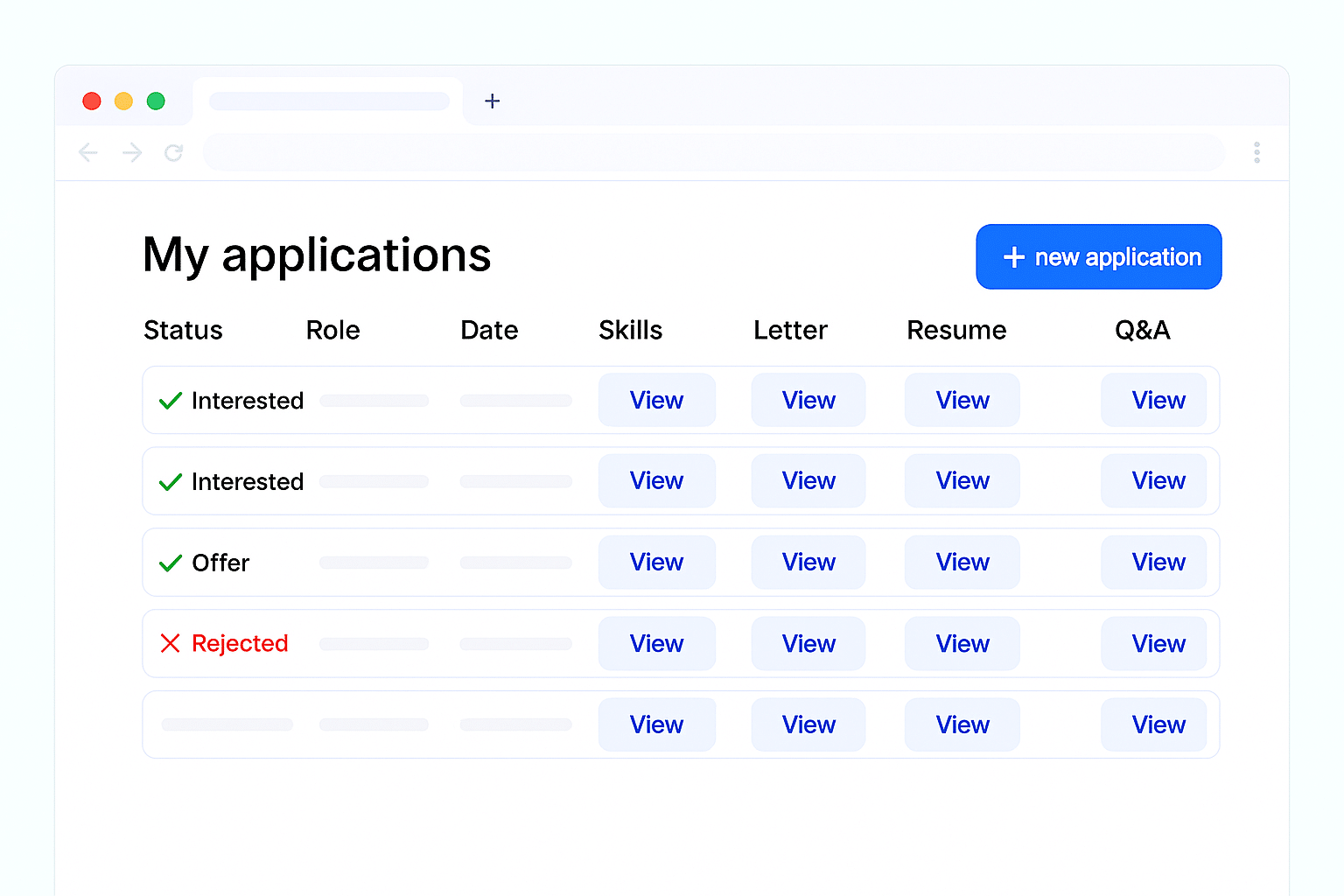
- Job tracker: Keeps every application organized so graduates (and advisors) can see where each opportunity stands.
- Marque blanche : The platform carries your bootcamp’s name and visual identity, reinforcing your program’s value rather than a third-party tool’s.
Why Bootcamp Placement Rates Stall (And Where AI Helps)
Most bootcamp career services teams are small. One or two advisors supporting hundreds of graduates is not unusual. That ratio makes it structurally impossible to give every graduate the level of personalized support that actually moves the needle on placement rates.
The result is a predictable pattern: the most motivated, most proactive graduates get the most advisor time. The graduates who are struggling quietly, who are not raising their hands, who are applying with an unoptimized resume and getting no responses, fall through the cracks.
AI career platforms change that equation. They handle the repeatable, process-driven work at scale, so every graduate gets a high-quality starting point regardless of whether they have booked an advisor session that week.
Where graduates lose momentum in the job search
| Scène | Common breakdown point | How AI addresses it |
|---|---|---|
| Resume preparation | Generic resume sent to every role; fails ATS filters | AI tailors resume to each job description in minutes |
| Application volume | Graduates apply to too few roles because tailoring feels overwhelming | Faster tailoring removes the friction; graduates apply to more roles |
| Cover letter | Generic or skipped entirely | AI generates a role-specific draft the graduate personalizes |
| Interview readiness | Graduates arrive underprepared; advisor bandwidth is the bottleneck | AI interview prep runs on demand, any time |
| Suivi des applications | Graduates lose track of where they applied; follow-up drops off | Centralized job tracker keeps the pipeline visible |
What This Looks Like in Practice: A Bootcamp Career Services Scenario
Consider a mid-size coding bootcamp with a 16-week full-stack development program. They graduate roughly 120 students per cohort, twice a year. Their career services team consists of two full-time advisors and one part-time employer relations coordinator.
Before adding an AI career platform, the workflow looked like this: graduates received a resume workshop in week 14, a cover letter template, and a list of recommended job boards. Advisors held 30-minute 1:1 sessions on request. The most engaged graduates booked multiple sessions. Many graduates never booked a single one.
Placement tracking was manual. Advisors followed up by email. Response rates were inconsistent. The reported placement rate at the 90-day mark was respectable, but the team suspected the real number was lower because graduates who stopped responding were counted as “outcome unknown” rather than “not placed.”
What changed after introducing an AI career platform
After integrating a white-label AI career platform into their post-graduation workflow, the team restructured their career services program around three phases.
Phase 1: Preparation (final two weeks of the program). Every graduate was onboarded to the platform before graduation. They used AI resume tailoring to build a base resume, then ran it through the ATS checker to identify gaps. Advisors reviewed the output in group sessions rather than one-on-one, freeing up significant time.
Phase 2: Active job search (weeks 1 to 8 post-graduation). Graduates used the platform independently to tailor their resume and cover letter for each application. The job tracker gave advisors a real-time view of who was applying, how many applications each graduate had submitted, and which graduates had gone quiet. That visibility let advisors proactively reach out to struggling graduates rather than waiting to be contacted.
Phase 3: Interview preparation. When graduates landed interviews, they used the platform’s AI interview prep tool to practice role-specific questions. Advisors reserved their 1:1 time for mock interview feedback and offer negotiation coaching, the conversations where human judgment genuinely matters.
Conseil d'initié : The most underrated benefit of an AI career platform is not what it does for graduates. It is what it tells advisors. When you can see that a graduate has submitted zero applications in three weeks, you can intervene early. That visibility is worth more than any single feature.
The outcomes
The team saw three measurable shifts. First, the average number of applications submitted per graduate in the first 30 days increased substantially, because the friction of tailoring had been removed. Second, advisors reported spending significantly more of their time on high-value coaching conversations and less on reviewing resume drafts. Third, the “outcome unknown” category shrank because the job tracker gave the team genuine visibility into graduate activity rather than relying on self-reporting.
These are directional outcomes based on how bootcamps using structured AI career support describe the change. They are not a guarantee for every program, and results will vary based on cohort size, employer network strength, and how deeply the platform is integrated into the curriculum.
How AI Career Platforms Fit Into Your Existing Career Services Program
One of the most common concerns from career services directors is integration. They already have a workflow, a set of employer relationships, and a team with established practices. They do not want to rebuild everything from scratch.
The right AI career platform does not replace your program. It plugs into it. Here is how the pieces typically fit together.
What the platform handles
- Resume tailoring at scale: Every graduate, every application, without advisor involvement unless the graduate requests a review.
- ATS optimization: Graduates get a score and specific feedback before they submit, reducing the number of applications that never reach a human reader.
- Cover letter drafts: The platform generates a starting point; the graduate adds their voice; the advisor reviews on request rather than from scratch.
- Interview practice: On-demand, role-specific, available at 11pm the night before an interview when no advisor is available.
- Progress tracking: A dashboard that shows advisor teams where each graduate is in the job search funnel.
What your advisors still own
- Coaching conversations: Helping a graduate understand why they keep getting to the second interview and not the offer. That is a human conversation.
- Employer relationships: Building and maintaining the partnerships that create direct referral pipelines. AI does not do business development.
- Offer evaluation and negotiation: Helping a graduate think through a compensation package, a relocation decision, or a culture fit question.
- Accountability and motivation: Checking in on graduates who have gone quiet, understanding what is blocking them, and helping them push through discouragement.
If you want to see how JobWinner’s white-label platform is structured for bootcamp career services teams, the bootcamp career services page walks through the specific feature set and how it maps to a typical career services workflow.
Evaluating an AI Career Platform: What to Look For
Not every AI career platform is built with bootcamps in mind. Some are consumer tools that offer a white-label option as an afterthought. Others are enterprise systems priced and configured for large universities, not for a lean career services team running two cohorts a year.
Here are the questions that separate a genuine fit from a poor one.
Five questions to ask any vendor
- Is the resume tailoring genuinely job-specific, or does it apply generic keyword stuffing? Ask for a live demo using a real job description from your employer network. The output should reflect the language and priorities of that specific role, not a generic list of keywords.
- Does the ATS checker reflect how real ATS software actually works? The best checkers are built on an understanding of how systems like Workday, Greenhouse, and iCIMS parse resumes. Ask the vendor to explain their methodology.
- What does the advisor dashboard look like? You need visibility into graduate activity, not just a tool graduates use independently. If the platform cannot tell you which graduates have been active and which have gone quiet, it is a consumer product, not a career services platform.
- How is the platform branded? White-label matters. Your graduates should associate the quality of the tool with your program, not with a third-party brand they might access independently after graduation.
- What does onboarding and support look like? A platform your team cannot configure and maintain without ongoing vendor hand-holding is a liability, not an asset. Ask about setup time, training, and what ongoing support looks like after the first 90 days.
Conseil d'initié : Ask vendors for a reference from a bootcamp of similar size to yours. A platform that works well for a 500-student university career center may be completely wrong for a 120-student cohort program. The use cases are genuinely different.
Manual career services vs. AI-assisted career services: a direct comparison
| Capability | Manual approach | plateforme de carrière IA |
|---|---|---|
| Personnalisation de CV | Advisor reviews drafts in 1:1 sessions; inconsistent across graduates | Every graduate gets tailored feedback on every application |
| Optimisation ATS | Advisor provides general guidance; no real-time scoring | Automated ATS score before every submission |
| Cover letters | Template provided; most graduates submit minimal variations | Role-specific draft generated per application; graduate personalizes |
| Interview prep | Mock sessions when advisor time allows; limited to scheduled hours | On-demand, role-specific practice available 24/7 |
| Progress visibility | Self-reported by graduates; significant gaps in data | Real-time dashboard showing application activity per graduate |
| Advisor time allocation | Split between administrative tasks and coaching | Concentrated on high-value coaching conversations |
| Évolutivité | Constrained by advisor headcount | Scales with cohort size without proportional staffing increase |
The ROI Case for Bootcamp Leadership
Career services is often viewed as a cost center. An AI career platform reframes it as a driver of the metric that matters most to prospective students and to your accreditation standing: placement rate.
The return on investment case has three components.
Placement rate improvement. Even a modest increase in your reported placement rate at 90 and 180 days has a compounding effect on enrollment. Prospective students research placement rates before committing to a program. A stronger number converts more inquiries into enrollments.
Advisor efficiency. If your advisors spend less time on resume reviews and cover letter drafts, they have more capacity for the conversations that drive placements. You may be able to serve a larger cohort without adding headcount, or you may be able to redirect advisor time toward employer development, which builds the referral pipelines that drive the best placement outcomes.
Graduate satisfaction and referrals. Graduates who feel well-supported during their job search are more likely to refer friends and colleagues to your program. Word-of-mouth is still the highest-converting enrollment channel for most bootcamps. A platform that makes graduates feel equipped rather than abandoned pays dividends in referrals.
For a detailed look at how organizations have structured the ROI case for an AI career platform investment, the post on L'IA au service des programmes d'employabilité covers the framework in depth.
Getting Started: How to Integrate an AI Career Platform at Your Bootcamp
The bootcamps that see the strongest results from AI career platforms are not the ones that simply hand graduates a login and hope for the best. They are the ones that build the platform into their curriculum and their post-graduation workflow deliberately.
A practical integration roadmap
- Start before graduation. Onboard graduates to the platform in the final two to four weeks of the program, while they are still in a structured learning environment. Build resume-building and ATS optimization into the curriculum rather than treating it as optional post-graduation activity.
- Set expectations clearly. Tell graduates what the platform does, what it does not do, and what they still need to bring to the process. AI produces a strong draft. The graduate brings their story, their judgment, and their voice.
- Build advisor workflows around the dashboard. Schedule a weekly team review of the graduate activity dashboard. Identify graduates who have gone quiet. Reach out proactively. The data is only valuable if the team acts on it.
- Collect outcome data consistently. Use the platform’s tracking capabilities to record first-job outcomes, time-to-placement, and compensation data. This data strengthens your accreditation reporting and your marketing materials.
- Iterate by cohort. After each cohort, review what worked and what did not. Which features did graduates use most? Where did they drop off? Use that data to improve your integration for the next cohort.
If you want to explore how JobWinner’s platform is configured for bootcamp programs specifically, you can schedule a demo to walk through the setup with a member of the team.
Questions fréquemment posées
What is an AI career platform for bootcamps?
An AI career platform for bootcamps is a software solution that automates and personalizes career support for graduates at scale. It typically includes tools for resume tailoring, ATS optimization, cover letter generation, interview preparation, and job tracking. Bootcamps use these platforms to deliver consistent, high-quality career support to every graduate without requiring a 1:1 advisor session for every task.
How can a bootcamp improve its job placement rate?
Improving placement rates starts with giving graduates the right tools at every stage of the job search: a tailored, ATS-optimized resume, a compelling cover letter, and strong interview preparation. AI career platforms automate the time-intensive parts of this process so graduates apply faster, apply smarter, and arrive at interviews better prepared. Career advisors can then focus their limited time on coaching conversations rather than administrative tasks.
What AI tools help bootcamp graduates find jobs?
The most impactful AI tools for bootcamp graduates include AI resume tailoring (matching the resume to each specific job description), ATS resume checkers (scoring the resume before submission), AI cover letter generators, and AI-powered interview preparation tools. Platforms like JobWinner bundle these into a single white-label environment that bootcamps can brand as their own.
How do coding bootcamps use AI for career services?
Coding bootcamps use AI career platforms to scale support beyond what a small advisor team can deliver manually. Graduates self-serve on resume tailoring, cover letter writing, and interview prep between advisor sessions. Advisors use the platform data to identify which graduates are struggling, where in the funnel they are dropping off, and where to focus their coaching time.
What software do bootcamps use for career support?
Bootcamps use a range of tools including career management platforms, ATS checkers, resume builders, and interview prep software. Increasingly, bootcamps are consolidating these into a single white-label AI career platform that covers the full job search journey, reduces tool sprawl for graduates, and gives the career services team a unified view of graduate progress.
If your career services team is doing good work but the placement numbers are not reflecting that effort, the constraint is usually not the quality of your advisors. It is the ratio of graduates to advisor hours. An AI career platform does not replace your team. It multiplies what they can do.
Ready to see how JobWinner’s platform works for bootcamp career services teams? Explore the bootcamp career services platform ou schedule a demo to walk through a setup built around your program’s specific needs.