 EN
EN  ES
ES  IT
IT  FR
FR 
At some point, almost every university career center director, bootcamp founder, or outplacement firm leader asks the same question: should we build a career tool ourselves, or license something that already works? It sounds like a straightforward technology decision. It is not. It is a strategic one, and the answer has real consequences for your budget, your team, and the job seekers who depend on you.
This guide breaks down the white label resume builder vs build your own decision honestly. No hype, no vendor spin. Just the trade-offs, the real costs, and a clear framework for choosing the right path for your organization in 2026.
The Quick Verdict: Which Option Is Right for You?
For most organizations, a white label resume builder is the right call. It gets you to market faster, costs less over the first three years, and lets your team focus on outcomes rather than infrastructure. Custom development makes sense in a narrow set of scenarios: when your platform requirements are genuinely unique, when you have an in-house engineering team already staffed, and when you have the runway to wait 18 to 36 months for a competitive product.
Here is the short version:
- Choose a white label platform if you are a university, bootcamp, outplacement firm, or career coaching business that needs to serve job seekers within the next 6 to 12 months without a significant engineering investment.
- Consider building your own only if your use case is so specific that no existing platform can serve it, you have a funded engineering team, and your leadership has appetite for a multi-year technology project.
The rest of this guide explains exactly why, with the numbers and trade-offs laid out so you can make the call confidently.
What Is a White Label Resume Builder?
A white label resume builder is a fully developed career platform that an organization licenses from a vendor and deploys under its own brand. Your logo, your colors, your domain. The underlying technology, AI models, and feature development belong to the vendor.
Think of it as the difference between opening a restaurant with your own kitchen versus licensing a proven restaurant concept with a tested menu. You still own the dining room experience. You just are not inventing the recipes from scratch.
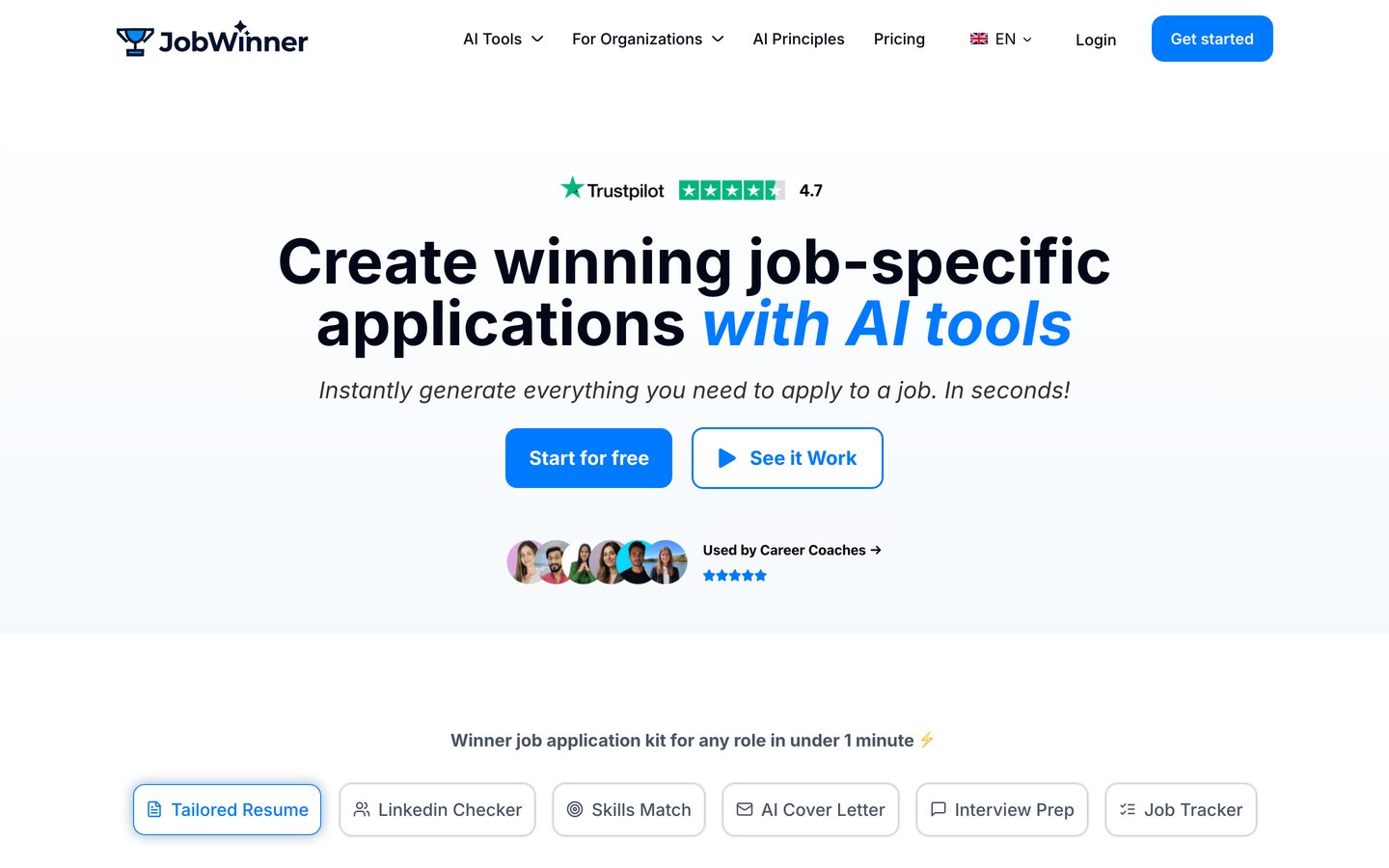
For career services teams, a white label platform typically includes some combination of AI-powered resume tailoring, an Applicant Tracking System (ATS) compatibility checker, cover letter generation, interview preparation tools, and a job tracker. The vendor handles hosting, security, and product updates. You handle the relationship with your students, graduates, or clients.
JobWinner’s white label career platform, for example, is used by universities, bootcamps, outplacement firms, and career coaches who want to offer their communities a polished AI career tool without building one. You can explore what that looks like at jobwinner.ai/career-platform.
What Does Building Your Own Resume Builder Actually Involve?
Building a resume builder from scratch is a software development project. That sounds obvious, but the scope surprises most non-technical decision-makers when they see the full picture.
At minimum, a competitive resume builder in 2026 needs to handle the following:
- Resume parsing and formatting: ingesting existing resumes in multiple formats (PDF, DOCX, LinkedIn) and rendering them cleanly across templates.
- ATS optimization logic: keyword matching, formatting rules, and scoring against job descriptions. This requires understanding how different ATS platforms (Workday, Greenhouse, iCIMS, Taleo) parse documents.
- AI tailoring: using large language models to suggest edits, rewrite bullet points, and match resume content to specific job postings.
- Template library: designing and maintaining a library of ATS-safe, visually appealing templates that work across devices.
- Cover letter generation: a separate but related AI workflow.
- Interview preparation: question banks, mock interview flows, feedback loops.
- Infrastructure: cloud hosting, data security, GDPR and FERPA compliance (critical for universities), uptime monitoring, and disaster recovery.
- Ongoing maintenance: ATS platforms change. AI models improve. Job market requirements shift. Someone has to keep the product current.
A small engineering team (3 to 5 developers) building this from scratch should expect 12 to 18 months to reach a basic MVP and 24 to 36 months to reach feature parity with established platforms. And that assumes the team stays intact, which is not guaranteed in a competitive hiring market for engineers.
Human-to-Human Tip: I have spoken with career services leaders at universities who budgeted $200,000 for a custom tool and ended up at $600,000 two years later with a product their students found frustrating. The problem was not the team. It was the scope creep that comes with any software project once real users start giving feedback. White label vendors have already absorbed that learning curve.
Feature-by-Feature Comparison: White Label vs Custom Build
Here is how the two options stack up across the dimensions that matter most to organizations making this decision.
| Dimension | White Label Platform | Custom Build |
|---|---|---|
| Time to launch | 2 to 8 weeks | 12 to 36 months |
| Upfront cost | Low to moderate (licensing fee) | High ($150K to $500K+ for MVP) |
| Ongoing cost | Predictable subscription | Engineering salaries, infrastructure, maintenance |
| AI features | Included and continuously updated | Must build and maintain separately |
| ATS optimization | Built in, vendor-maintained | Must reverse-engineer and keep current |
| Branding control | Full brand customization | Full brand control |
| Data ownership | Varies by vendor contract (negotiate carefully) | Full ownership |
| Compliance (FERPA, GDPR) | Vendor handles; verify certifications | Your team’s responsibility |
| Feature roadmap | Vendor-driven (you can influence, not control) | Fully in your control |
| Scalability | Handled by vendor infrastructure | Your team’s responsibility |
| Integration flexibility | API access varies by vendor | Unlimited (you own the codebase) |
| Risk profile | Vendor dependency risk | Execution risk, cost overrun risk |
Where a White Label Platform Wins
There are four scenarios where a white label resume builder is the clearly superior choice. If your organization fits any of these, the build option is likely a distraction from your actual mission.
You need to serve students or clients within the next 12 months
Career services teams are measured on outcomes: placement rates, time to employment, salary outcomes. Every month you spend in development is a month your community is not getting the support they need. A white label platform can be live in weeks, not years. For a university with an accreditation review coming up or a bootcamp trying to improve its placement stats before the next cohort graduates, that timeline difference is decisive.
You do not have an in-house engineering team
Building a resume builder requires sustained engineering capacity. Not a one-time project. Ongoing development, bug fixes, AI model updates, and compliance work. If your organization does not already have that team in place, you would need to hire it, which adds recruiting costs, ramp-up time, and retention risk on top of the development costs. For most career services operations, that is not a sensible use of budget.
Your core competency is career development, not software
Universities are good at education. Bootcamps are good at training. Outplacement firms are good at transition support. Career coaches are good at coaching. None of these organizations have software development as a core competency, and that is fine. The white label model exists precisely so that organizations can deliver great career tools without becoming software companies. You focus on the human relationship. The vendor focuses on the technology.
You want AI features that stay current without internal investment
AI in career tools is moving fast. The ATS landscape is shifting. What counted as a good resume optimization tool 18 months ago is already outdated. A white label vendor whose entire business depends on keeping their platform competitive will invest continuously in AI improvements. An internal team at a university or bootcamp will always have competing priorities pulling them away from the career tool. The vendor’s incentive structure is simply better aligned with continuous improvement.
Where Building Your Own Wins
Custom development is not always the wrong answer. There are specific situations where it makes strategic sense.
Your requirements are genuinely unique
If your organization has workflow requirements, data structures, or integration needs that no existing platform can accommodate even with customization, building is worth considering. This is rare. Most organizations discover, after a thorough vendor evaluation, that their needs are more standard than they initially assumed. But it does happen, particularly in large enterprise or government contexts with unusual compliance requirements.
You have a funded engineering team already staffed
If your organization already employs engineers building adjacent products, adding a resume builder to the roadmap is a different calculation than hiring a team from scratch. The marginal cost is lower. The execution risk is lower. The institutional knowledge is already there. This scenario applies more often to large job boards or HR technology companies than to universities or bootcamps.
You have a multi-year runway and leadership alignment
Custom builds take time and rarely go exactly to plan. If your leadership understands and accepts that the product will take two to three years to reach a competitive state, and your budget is secured for that period, the build option becomes more viable. Without that alignment, a custom build often stalls mid-development when priorities shift or budgets tighten.
Human-to-Human Tip: The organizations I have seen succeed with custom builds almost always had one thing in common: a technical co-founder or a CTO-level leader who owned the project personally. When the technology decision is made by a committee without deep engineering representation, custom builds tend to underdeliver.
The Real Cost Comparison: What Organizations Actually Spend
Cost is where the build vs buy decision often gets settled. Here is a realistic breakdown.
Cost of building from scratch
Estimates vary widely depending on team size, location, and feature scope, but a realistic range for a competitive resume builder MVP looks like this:
- Engineering team (3 to 5 developers, 12 months): $300,000 to $600,000 in salary and benefits, depending on market.
- AI model costs (API usage, fine-tuning): $20,000 to $80,000 per year at meaningful scale.
- Infrastructure (cloud hosting, CDN, security): $15,000 to $50,000 per year.
- Compliance and legal (FERPA, GDPR, SOC 2): $20,000 to $60,000 upfront, plus ongoing audit costs.
- Design and UX: $30,000 to $80,000 for a polished initial product.
- Ongoing maintenance (post-launch): 20 to 30% of initial build cost per year.
A conservative total for year one: $400,000 to $800,000. Years two and three add ongoing engineering, infrastructure, and maintenance. By year three, a custom build rarely costs less than $1,000,000 in total investment for a mid-sized organization.
Cost of a white label platform
White label licensing costs vary by vendor, user volume, and feature set. Typical ranges for organizations:
- Small bootcamp or career coaching firm (under 500 users): $500 to $2,000 per month.
- Mid-sized university or outplacement firm (500 to 5,000 users): $2,000 to $8,000 per month.
- Large university or enterprise (5,000+ users): Custom pricing, typically negotiated annually.
Over three years, even a mid-sized organization spending $5,000 per month totals $180,000. That is a fraction of the custom build cost, and it includes continuous feature updates, AI improvements, and vendor support.
| Cost Category | White Label (3-year total) | Custom Build (3-year total) |
|---|---|---|
| Development / licensing | $18,000 to $288,000 | $400,000 to $800,000 |
| Engineering salaries | $0 (vendor’s cost) | $600,000 to $1,200,000 |
| Infrastructure | Included in licensing | $45,000 to $150,000 |
| Compliance | Vendor-handled (verify) | $60,000 to $180,000 |
| Estimated 3-year total | $18,000 to $288,000 | $1,100,000 to $2,330,000 |
These are estimates, not guarantees. But the order of magnitude difference is consistent across the organizations I have spoken with. The build option costs more, takes longer, and carries more execution risk.
If you want to see what a white label career platform looks like in practice for universities and bootcamps, the JobWinner case studies page has real examples of organizations that made this decision.
Who Should Choose What: A Decision Matrix
Here is a practical breakdown by organization type.
| Organization Type | Recommended Path | Primary Reason |
|---|---|---|
| University career services | White label | No engineering team, compliance complexity, need for fast deployment |
| Coding bootcamp | White label | Tight margins, placement rate pressure, small staff |
| Outplacement firm | White label | Client-facing speed matters; building distracts from service delivery |
| Career coaching business | White label | Scaling 1:1 coaching without hiring; white label enables this efficiently |
| Large job board or HR tech company | Build or hybrid | Engineering team exists; deep integration needs; differentiation through proprietary data |
| Government workforce agency | Evaluate both carefully | Compliance requirements may favor build; budget cycles may favor white label |
What to Look for in a White Label Resume Builder
If you have decided that white label is the right path, not all platforms are equal. Here are the criteria that matter most for organizations evaluating vendors.
ATS optimization that is actually current
ATS platforms change their parsing rules. A vendor that built their ATS optimization logic two years ago and has not updated it since is selling you a false sense of security. Ask vendors specifically how often they update their ATS compatibility logic and which platforms they test against. The major ones to confirm: Workday, Greenhouse, iCIMS, Taleo, Lever, and SmartRecruiters.
Genuine AI tailoring, not template filling
Some platforms market themselves as AI-powered but are essentially template engines with a keyword highlighter. Genuine AI tailoring reads the job description, understands the role requirements, and suggests specific edits to the resume content. Ask for a live demo with a real job posting, not a scripted walkthrough.
Full brand customization
Your students and clients should experience the tool as yours. That means your logo, your color palette, your domain, and ideally your onboarding flow. Vendors who offer only superficial branding (a logo in the corner) are not truly white label. Confirm exactly what customization is included in the contract.
Data ownership and privacy compliance
This is non-negotiable for universities (FERPA) and any organization serving EU users (GDPR). Your contract should specify clearly that your users’ data belongs to your organization, not the vendor. Confirm the vendor’s data processing agreements, their data retention policies, and their breach notification procedures.
Reporting and outcome tracking
Career services teams need to demonstrate impact. A good white label platform gives administrators a dashboard showing usage data, resume completion rates, ATS scores, and ideally employment outcomes. If the vendor cannot show you what your students are doing with the tool, you cannot make the case for renewal or expansion.
Integration with your existing systems
Universities typically use student information systems (Banner, PeopleSoft, Slate). Bootcamps use LMS platforms. Outplacement firms use case management systems. Ask about API access and existing integrations. A platform that lives in total isolation from your other systems creates friction for both administrators and end users.
Human-to-Human Tip: When evaluating vendors, ask to speak with two or three existing customers who are similar to your organization. Not references the vendor hand-picks, but customers you find independently through their public case studies or LinkedIn. The questions that matter: how long did onboarding actually take, what broke in the first 90 days, and how responsive is the support team when something goes wrong.
The Hybrid Option: White Label Now, Build Later
There is a third path that some organizations overlook: start with a white label platform and build proprietary features on top over time.
This approach makes sense when you have a long-term vision for a differentiated product but need to serve your community now. You license a white label platform to get to market quickly, gather real user data, and understand what your specific community actually needs. Then, over 18 to 24 months, you invest in building the proprietary features that differentiate you, while the white label platform handles the core functionality.
This requires a vendor who offers API access and does not lock you into a closed ecosystem. It is worth asking about explicitly during vendor evaluation if this is your direction.
For organizations considering this path, the JobWinner white label AI resume builder is designed with integration flexibility in mind. It is worth exploring what that looks like for your specific stack.
Frequently Asked Questions
Should my university build its own resume tool or use a white label platform?
For most universities, a white label platform is the faster, lower-risk choice. Building from scratch requires a dedicated engineering team, ongoing maintenance budget, and 12 to 24 months before students see a working product. A white label solution can be deployed in weeks, branded to your institution, and updated continuously by the vendor.
Is it cheaper to build a resume builder or license a white label one?
Licensing a white label resume builder is almost always cheaper in the first three years. Custom development typically costs $150,000 to $500,000 or more upfront, plus ongoing engineering and infrastructure costs. White label licensing fees are predictable and spread across time, with no surprise infrastructure bills.
What are the pros and cons of white label resume builders versus custom development?
White label platforms offer speed, lower cost, and continuous feature updates, but you depend on the vendor’s roadmap and have limited control over the underlying architecture. Custom builds give you full control and deep integration flexibility, but require significant upfront investment, a technical team, and years to reach feature parity with established platforms.
How long does it take to build a resume builder from scratch?
A basic resume builder takes roughly 6 to 12 months to reach a usable MVP, assuming a small dedicated engineering team. A full-featured platform with ATS optimization, AI tailoring, cover letter generation, and interview prep typically takes 18 to 36 months and requires ongoing investment to stay competitive.
Why do bootcamps use white label resume tools instead of building their own?
Bootcamps operate on tight margins and need to show placement results quickly. Building a resume tool in-house diverts resources from curriculum and instruction. White label platforms let bootcamps offer polished, AI-powered career tools under their own brand without the engineering overhead, so they can focus on what they do best: training graduates.
If you are ready to see what a white label career platform looks like for your organization, schedule a demo with the JobWinner team. We will walk you through the platform, answer your specific questions about customization and compliance, and give you a realistic picture of what onboarding looks like. No pressure, no scripted pitch.