 EN
EN  ES
ES  IT
IT  FR
FR 
You open a blank resume, stare at a bullet that says “Responsible for project coordination,” and know it is not doing you any favors.
Then the interview starts, things feel fine, and you hear the question that knocks even strong candidates off balance: “Tell me about yourself.”
Those two moments are connected more than most job seekers realize. If you learn how to write achievements resume content well, you also make interview answers easier, sharper, and far more convincing. The strongest candidates do not switch personas between resume and interview. They carry the same proof of value into both.
A weak resume lists duties. A strong one shows outcomes. A weak interview answer recites a biography. A strong one gives a focused story about relevance, results, and fit.
That is the standard to aim for.
This guide shows how to build achievement-driven resume bullets and then turn them into a natural “Tell me about yourself” answer. You will get practical frameworks, examples for different career stages, and a direct way to handle the hardest part for many candidates: turning messy experience into clean, credible proof.
That Dreaded Question 'So, Tell Me About Yourself'
The panic usually starts because the question sounds personal but is strategic.
Candidates hear “tell me about yourself” and assume they should start at the beginning. They talk about where they studied, why they picked their major, their first internship, maybe even hobbies. None of that is automatically wrong. It is just rarely the best answer.
Recruiters and hiring managers are trying to form a fast first impression. Your resume faces the same pressure. Data shows resumes lacking metrics are skipped 70% more often by recruiters according to Shaw Career Consulting’s discussion of quantifiable achievements. The spoken version of your story works the same way. If your opening answer lacks clear impact, it is harder to hold attention.
Why this question feels harder than it should
The challenge is not a lack of material. It is too much material.
You know your whole work history. The interviewer does not. So when you answer without a filter, you tend to over-explain. The result is a wandering summary instead of a persuasive opening.
Common versions of the weak answer sound like this:
- The life story answer: You start with school and move year by year.
- The job-description answer: You repeat responsibilities already visible on the resume.
- The personality answer: You focus on being hardworking, motivated, and passionate without proof.
- The panic answer: You speak until you find a point, instead of starting with one.
What the question really gives you
This is not a trap. It is your best chance to set the frame.
A good answer says, in effect: here is the work I am known for, here are the results I have produced, and here is why that matters for this role.
That is why your resume achievements matter so much. They are not just lines on a document. They are the raw material for your opening pitch.
Tip: If your answer would still make sense with your name removed and any company swapped in, it is too generic.
A useful way to prepare is to think of your answer as a bridge between your resume and the role in front of you. Start with your strongest proof, not your oldest history. Then shape the rest around relevance.
If you want to sharpen your full interview preparation beyond this one question, JobWinner’s guide to common interview questions and answers is a practical next read.
Decoding What Recruiters Really Want to Hear
An interviewer asks, “Tell me about yourself,” and the candidate gives a polished answer for 90 seconds. By the end, the recruiter has already decided three things. Can this person solve the problems tied to the role? Can they explain their value without wandering? Does their story point in the same direction as this job?
That is the central test.
Recruiters are not asking for a biography. They are listening for a pattern. Your resume achievements matter here because they give you proof points to speak from, not just traits to claim. The same material that strengthens a bullet point also strengthens your opening answer.
The three silent questions behind the question
Are you qualified for this role
Recruiters listen for evidence fast. They want signs that your past work matches the kind of work they need done now.
That usually means hearing outcomes, scope, or clear ownership. “Managed social media” is thin. “Grew engagement by improving content planning and campaign timing” is stronger because it points to a result and how you got there. If you have numbers, use them. If you do not, name the business impact in plain language.
This is also why resume achievement writing and interview prep belong together. The bullet that earns attention on paper often becomes the line that earns trust in conversation. For a useful outside perspective on how employers screen for relevance and proof, see these insider secrets employers look for when crafting a standout Europass CV.
Can you communicate with judgment
Strong candidates do not dump everything they have done. They choose what helps the listener understand them quickly.
Good judgment sounds like this:
- Lead with the work you are known for
- Pick examples that fit the role, not your full history
- Use language a non-specialist recruiter can follow
- Show progression, even if your path has not been linear
This matters even more for career changers and new graduates. A career changer needs to translate experience instead of defending it. A new graduate needs to show evidence of readiness, even if that evidence comes from internships, projects, campus leadership, or part-time work. In both cases, the recruiter is listening for the same thing. Can this person connect their background to this role without making me do the math?
Does your story have direction
Direction is different from “fit.”
Fit gets used loosely. Direction is clearer. It answers whether your next move makes sense based on the story you just told. If your answer centers on process improvement, then an operations role feels logical. If your strongest examples are client communication, retention, and issue resolution, then a customer success or account role makes sense.
Here, candidates often lose credibility. They present one identity on the resume and a different one in the interview. The fix is consistency. Your resume achievements should establish the themes. Your answer should reinforce them.
A simple way to test that consistency is to compare your spoken story with the keywords and priorities already built into your resume. If you need to tighten that written alignment first, review how to pass ATS systems with your resume.
Your answer works like a headline with proof
A recruiter does not need your whole backstory in the opening minutes. They need the clearest version of your professional value.
That means selecting a few details with high signal.
| What recruiters want to hear | What weakens the answer |
|---|---|
| Relevant experience tied to the role | A full chronological history |
| Achievements that show impact | Task lists with no outcome |
| A clear professional theme | Generic adjectives like hardworking or passionate |
| A logical next step | A vague statement about being open to anything |
The practical rule is simple. If a point strengthens both your resume and your “Tell me about yourself” answer, keep it. If it only fills space, cut it.
Key takeaway: Your resume holds the evidence. Your opening answer gives that evidence a clear, believable narrative.
Crafting Your Core Narrative A Repeatable Framework
You are 30 seconds into an interview. The recruiter says, "Tell me about yourself," and you can feel two risks at once. Rambling makes you sound unfocused. Reciting your resume line by line makes you sound forgettable.
Structure solves both problems.
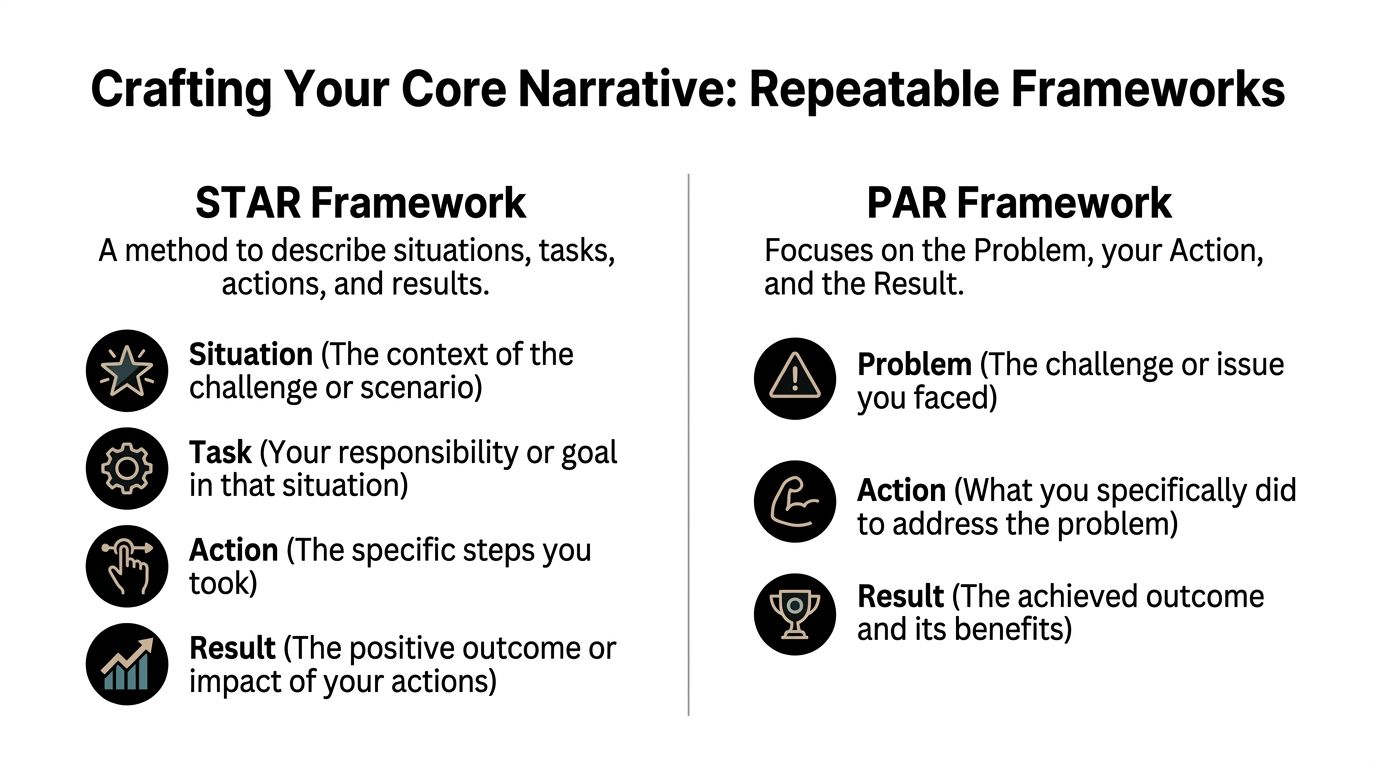
A strong answer and a strong resume use the same raw material. The resume gives the proof. Your opening answer turns that proof into a clear, spoken narrative. If those two pieces do not match, interviewers notice.
Two frameworks that hold up in real interviews
I coach candidates to prepare two versions of their story. One should be broad enough for a standard screening call. The other should be built around one high-value example you can tell with energy and precision.
Present Past Future
Present Past Future works well for candidates whose background already points toward the role they want. It gives you a professional identity, a few proof points, and a sensible reason for why you are in this conversation.
Present
State who you are now in terms of function and value.
Past
Choose two or three achievements that explain why that identity is credible.
Future
Connect that pattern to the role you want next.
Example shape:
- Present: “I’m a marketing coordinator focused on lifecycle campaigns, email performance, and conversion testing.”
- Past: “In my current role, I supported A/B tests and revised messaging across key nurture sequences, which helped improve conversion rates by 12%.”
- Future: “I’m ready for a role where I can own more of the campaign strategy and work more closely with product and sales.”
This format is reliable because it gives the listener a clean arc. It also keeps early-career candidates from drifting into a full autobiography.
STAR pitch
STAR stands for situation, task, action, result. For an opening answer, it needs to be tighter than a behavioral interview story. I call this a STAR pitch because the goal is not to give every detail. The goal is to show how you solve the kind of problem the employer cares about.
This format is especially useful for project managers, operators, analysts, consultants, and career changers. It also helps new graduates who have one internship, capstone, or campus leadership example doing a lot of heavy lifting.
Example shape:
- Situation/Task: “My team was missing reporting deadlines, and leaders were making decisions with outdated data.”
- Action: “I rebuilt the reporting workflow, clarified ownership, and set a weekly quality check.”
- Result: “Reporting became more consistent, and project completion time dropped by 20% over three months.”
Then add the link to the target role: “That is the kind of process improvement work I want to keep doing in an operations role.”
PAR is the sentence-level formula underneath both frameworks
Whether you use Present Past Future or a STAR pitch, the strongest achievement lines usually follow PAR, which stands for Problem, Action, Result.
That matters because weak resumes and weak interview answers often get stuck at the action. They tell me what someone did. They do not tell me why it mattered.
Compare the difference:
- Weak: “Managed restaurant inventory.”
- Stronger: “Fixed inconsistent restaurant inventory tracking, introduced a tighter counting process, and improved inventory accuracy to 98% while reducing annual costs by 15%.”
That second version gives you something to say in both places. It becomes a resume bullet, and it also becomes a spoken proof point inside your interview answer.
Choose the framework that matches your situation
Here is the comparison I use with clients.
| Framework | Best For | Structure | Example Focus |
|---|---|---|---|
| Present Past Future | Candidates whose experience already aligns with the target role | Current identity, relevant background, next-step logic | “I’m a customer success specialist who has improved retention and now wants a larger book of business.” |
| STAR pitch | Candidates with one standout project or a less direct path into the role | Situation, task, action, result, relevance | “I fixed a workflow problem, improved delivery, and want to bring that systems mindset into operations.” |
| PAR for bullets | Resume writing and interview proof points | Problem, action, quantified result | “Resolved a scheduling bottleneck, which improved turnaround time.” |
The trade-off is simple. Present Past Future is easier to remember and easier to adapt. STAR pitch is more persuasive when you need one story to carry credibility fast.
A practical build process
Candidates often try to write the polished answer first. That usually creates generic language because the necessary evidence has not been gathered yet.
Start with the raw material.
Step 1. List wins before you try to wordsmith them
Open a notes app, document, or spreadsheet. Write down moments where you:
- Improved a process
- Saved time or money
- Helped customers or clients succeed
- Increased revenue, conversion, output, or quality
- Led a project, initiative, or handoff
- Solved a visible problem
Messy notes are fine. Fragments are fine. You are collecting proof, not writing prose.
Step 2. Turn duties into evidence
Take any responsibility from your resume and ask:
- What problem or goal sat behind this work?
- What did I do?
- What changed because of my work?
- What proof can I mention?
For deeper examples in a technical hiring context, Underdog has a useful piece on how to write a tech resume that beats ATS, especially if your work involves systems, product, engineering, or measurable delivery.
Step 3. Build one bullet, then one spoken version
Write the achievement in PAR form first. Then say it out loud as part of your introduction.
That step matters more than people realize. If a bullet is awkward to say, it is usually too stuffed with jargon or missing the core result. If you want help finding metrics before you draft the final version, this guide on how to quantify achievements on your resume with AI-powered strategies can help you convert vague contributions into clearer proof.
Step 4. Adapt for your career stage
Career changers should emphasize transferable patterns, not apologize for having a nonlinear background. A former teacher moving into customer success can highlight stakeholder communication, conflict resolution, retention, training, and measurable student or program outcomes.
New graduates should stop assuming they need full-time experience before they can sound credible. Internships, student jobs, research, campus leadership, freelance work, and major class projects all count if the example shows ownership and a result.
What strong material sounds like
Works
- Clear verbs such as led, improved, delivered, launched, resolved
- Numbers with context
- Scope that shows scale, complexity, or ownership
- Language that matches the target role
- A closing line that explains why this experience points to the next step
Weakens your answer
- “Responsible for”
- “Helped with”
- “Worked on”
- Claims about being hardworking or passionate with no proof
- Long setup before the result
- A story that sounds polished on the resume but unnatural out loud
Authenticity still matters. Frameworks are not scripts you memorize word for word. They are guardrails that keep your answer clear, credible, and consistent with the achievements already sitting on your resume.
Customizing Your Story for Maximum Impact
The biggest mistake candidates make is assuming a good answer is reusable without edits.
It is reusable in structure, not in wording.
A generic answer wastes your best material because it forces the interviewer to connect the dots for you. Good candidates do not make recruiters do that work.
Read the job description like a detective
Do not skim for the title and apply.
Study the language. Look for repeated skills, repeated problems, and repeated signals about how success is measured. Usually, the priorities show up in plain sight.
Focus on three categories:
- Core skills: tools, functions, workflows, or domain knowledge
- Business goals: growth, efficiency, project delivery, customer outcomes
- Values or style: collaboration, ownership, pace, ambiguity, stakeholder management
Make a short list of the 3 to 5 themes that show up most often.
Match your proof to their priorities
Now go back to your experience and map achievements to those themes.
If the role emphasizes project delivery, choose achievements about timelines, coordination, and successful execution. If it emphasizes sales or growth, lead with revenue, clients, conversions, or pipeline impact. If it emphasizes leadership, use examples where you aligned people, resolved friction, or improved team outcomes.
Many people freeze here, especially early-career candidates and career changers. The problem is real. A critical gap in career advice is helping entry-level and career-changing professionals quantify achievements from non-traditional experience, even though experts commonly recommend 3 to 4 key achievements per role, as noted in Indeed’s guide to achievement-based resumes.
That means volunteer work, academic research, student leadership, freelance projects, and side projects are not backup material. They are valid source material if framed correctly.
How to translate non-traditional experience
A recruiter does not care whether the work happened in a Fortune 500 office or a campus organization. They care whether it shows relevant capability.
Here is how to reframe common “I do not have enough experience” material:
| Raw experience | Weak description | Stronger achievement angle |
|---|---|---|
| University group project | Worked on class presentation | Led a team, solved a problem, presented findings, improved process or outcome |
| Volunteer event | Helped at nonprofit event | Coordinated logistics, managed signups, communicated with stakeholders |
| Freelance work | Did design for small clients | Delivered projects, met deadlines, improved client materials or engagement |
| Student club role | Member of marketing club | Organized initiatives, managed campaigns, grew participation, created assets |
A simple customizing method you can reuse
Start with the role’s top demand
Pick the one problem the company seems to care about most.
That becomes the center of your answer.
Choose one or two achievements that prove you can handle it
Not five. Not your full history. Just enough evidence to be believable and memorable.
Rewrite your opening line to fit that demand
Compare these:
- “I have experience in operations and customer service.”
- “I’ve spent the last few years improving operational workflows and customer-facing processes, which is why this operations role stood out.”
The second version immediately sounds more aligned.
Tip: Customizing is not embellishment. It is selection.
For career changers and new graduates
This group often underestimates how much proof they already have.
If you are changing fields, your task is to identify transferable achievements, not pretend you already held the target title.
For example:
- A teacher moving into project coordination can highlight planning, stakeholder communication, deadline management, and process ownership.
- A retail supervisor moving into customer success can highlight relationship building, issue resolution, team support, and service metrics.
- A graduate applying for an analyst role can highlight research, structured problem-solving, presentations, and data-based recommendations from coursework or internships.
If you need a repeatable way to customize your resume before you customize your spoken pitch, use this guide on how to tailor your resume for every job application.
The principle is simple. Match proof to need. Everything gets easier after that.
Example Scripts for Every Career Stage
Examples help because they show what “good” sounds like in full sentences, not just bullet fragments.
Use these as models, not templates to copy word for word. The goal is to sound prepared, not borrowed.
A quick primer before the scripts:
Entry-level candidate
Target role: marketing coordinator
Script
“I recently finished my degree and built most of my practical experience through internships, campus projects, and student-led work. The common thread has been communication and performance-focused marketing. In one project, I helped test messaging and improve campaign engagement, and I became especially interested in how small changes in copy and audience targeting can affect outcomes. I’m now looking for a marketing coordinator role where I can bring that hands-on project support, strong organization, and willingness to learn quickly in a team that values execution and experimentation.”
Why this works:
- It does not apologize for being early-career.
- It treats academic and internship experience as real evidence.
- It points to a direction instead of repeating “I’m eager to learn.”
If you are building your first version of this kind of profile, JobWinner’s roundup of student resume examples for a first job can help you identify what belongs on the page before you turn it into an interview answer.
Career changer
Target role: project coordinator, coming from education
Script
“I’ve spent the last several years in education, where a big part of my work was coordinating moving pieces, aligning stakeholders, and keeping projects on track under tight timelines. What pushed me toward project coordination as a career path was realizing that the part I enjoyed most was building systems, clarifying responsibilities, and making sure execution stayed smooth. In my previous role, I regularly managed competing deadlines, communicated across groups with different priorities, and solved process issues before they became larger problems. I’m now looking to bring that structure, communication, and delivery mindset into a project-focused role in a business setting.”
Why this works:
- It bridges, rather than hides, the previous career.
- It makes the “why” behind the pivot sound intentional.
- It uses transferable proof instead of title-matching.
Tooltip: A good career-change script answers the unspoken question “Why should we take this leap with you?” before the interviewer asks it.
Experienced professional
Target role: senior HR or operations leader
Script
“I’m an HR leader with a track record of building programs that improve delivery across complex organizations. Over the course of my recent work, I’ve focused on cross-functional execution, stakeholder alignment, and making sure initiatives move from planning into measurable results. One achievement I’m especially proud of was executing 20 company-wide HR projects resulting in an 85% to 95% success rate by aligning resources and expectations, a benchmark discussed in Flair’s resume statistics article. I’m interested in this role because it combines strategic planning with operational follow-through, and that is where I do my strongest work.”
Why this works:
- It establishes seniority quickly.
- It uses one concrete benchmark without becoming a data dump.
- It ties leadership to execution, which many senior roles require.
What to notice across all three scripts
The structure changes a little. The discipline does not.
Each script does four things:
- States a professional identity
- Offers proof, not vague traits
- Highlights relevance to the target role
- Ends with a clear forward direction
The candidates who perform best usually sound calm because they are not improvising their relevance. They already decided what matters before the interview began.
Perfecting Your Delivery and Avoiding Common Pitfalls
A strong script can still land badly if you deliver it like a memorized speech.
The goal is prepared and conversational. Not robotic. Not rambling.
The mistakes that hurt good candidates
Some problems show up constantly.
- Too long: If your answer keeps looping, you lose momentum.
- Too broad: If you mention everything, nothing stands out.
- Too humble: Many people bury their best result under soft language.
- Too rehearsed: If every sentence sounds recited, it creates distance.
- Too generic: If the answer could fit ten different roles, it does not feel custom.
Another major issue is credibility. If you use numbers, make sure you can explain them. How was the result measured? What was your part? What changed because of your work?
Delivery habits that make a difference
Pace
Slow down slightly at the start. Most candidates rush the first two sentences because of nerves.
Eye contact
Steady, natural eye contact helps more than perfect wording. If you are in a video interview, look at the camera at key moments, especially when you state your strongest result.
Voice
Aim for grounded, not over-energized. You do not need to sound like you are delivering a pitch deck.
Posture
Sit or stand in a way that lets you breathe fully. A compressed posture makes answers sound tighter and less confident.
Tip: Practice until you can say the answer three different ways without losing the main points. That is how you know it is learned, not memorized.
Practice in layers
Do not only practice the final script. Practice the components.
- Write your achievement bullets clearly
- Turn them into a 60 to 90 second answer
- Say it out loud
- Trim anything that sounds written
- Practice follow-up questions on each achievement
This is one area where tools can help if you use them properly. For example, JobWinner includes resume customizing, achievement-focused bullet generation, and interview preparation based on the job description and your background. Used well, that can help you tighten both the written and spoken version of your story. It should support your thinking, not replace it.
What matters most is authenticity. Candidates do not lose offers because they sounded too natural. They lose momentum when they sound vague, inflated, or disconnected from the role.
Your Story Is Your Greatest Asset
A strong resume achievement is not just a bullet point. It is evidence. And that evidence becomes the backbone of your interview story.
When you know how to write achievements resume content with clarity, relevance, and proof, “Tell me about yourself” stops feeling open-ended. It becomes focused. You know what to highlight, what to cut, and how to connect your past work to the role in front of you.
Structure helps. Customizing matters. Authenticity closes the gap.
If you want a faster way to turn raw experience into custom resume bullets, role-matched interview answers, and application-ready documents, JobWinner can help organize that work. It customizes resumes to job descriptions, generates cover letters, analyzes fit, prepares interview questions, and keeps your applications in one place so you can spend less time rewriting and more time applying well.