 EN
EN  ES
ES  IT
IT  FR
FR 
Ever feel like your resume just vanishes into thin air? You spend hours perfecting it, send it off for a job you know you’re qualified for, and then… nothing. It’s a frustratingly common experience, but the problem usually isn’t your qualifications. It’s a robot.
Why Your Resume Disappears into a Black Hole
The hard truth is that before a person ever sees your application, it has to get past an invisible gatekeeper: the Applicant Tracking System, or ATS. Nearly every large and mid-sized company uses this software to sort through the hundreds, sometimes thousands, of resumes they receive for a single opening.
This system is the main reason why perfectly good applications get lost in the digital shuffle. The first step to getting noticed is understanding how to optimize resume for ATS and beating the bots.
The Digital Barrier You Must Overcome
Think of the ATS as a bouncer with a very specific list. It doesn't read for context or appreciate your unique career path; it simply scans for keywords and phrases that perfectly match the job description. If that match isn't strong enough, your resume is automatically filtered out. A hiring manager will never even know you applied.
The numbers are pretty stark: a staggering 75% of resumes are rejected by an ATS before a human recruiter ever sees them. This isn't because the candidates are unqualified; it's because their resumes don't speak the machine's language.
This digital barrier is the single biggest hurdle in a modern job search. Your incredible experience means nothing if the software can't find the exact terms it’s looking for.
Keywords and Formatting: The Two Main Culprits
So, what's causing all these rejections? It almost always boils down to two simple things: missing keywords and confusing formatting.
Recent data shows that:
- 68% of ATS rejections are due to a simple lack of keywords from the job description.
- 70% of rejections happen because the resume’s formatting—things like columns, graphics, or fancy fonts—confuses the software.
It’s a one-two punch that knocks out even the most qualified applicants. For a deeper dive into this technology, check out our guide on what an Applicant Tracking System is and how it works.
Here’s a quick look at how tiny differences in phrasing can get you filtered out. These might seem like minor details to a person, but to a bot, they're a total mismatch.
| Your Resume Says | The Job Description Wants | ATS Decision |
|---|---|---|
| "Led a sales team" | "Experience with sales leadership" | Mismatch |
| "Knowledge of digital marketing" | "Proficiency in SEO and SEM" | Mismatch |
| "Managed client accounts" | "Client relationship management" | Mismatch |
Learning to spot and use these exact keywords isn't just a good idea—it's the only way to make sure your resume actually lands on a hiring manager's desk.
Decoding Job Descriptions for Winning Keywords
Think of a job description as your personal cheat sheet for getting hired. It's not just a list of demands; it’s a roadmap filled with the exact words and phrases the company's Applicant Tracking System (ATS) is programmed to look for. Your first mission is to get past this digital gatekeeper, and to do that, you have to become an expert at breaking down these job postings.
This goes way beyond just grabbing the obvious technical terms. You need to put on your detective hat and find the full spectrum of language the hiring manager used. Mastering this is the absolute key to tailoring your resume and showing you're the perfect fit.
It's a tough reality, but most resumes never even reach a human. This flowchart shows exactly where things go wrong.
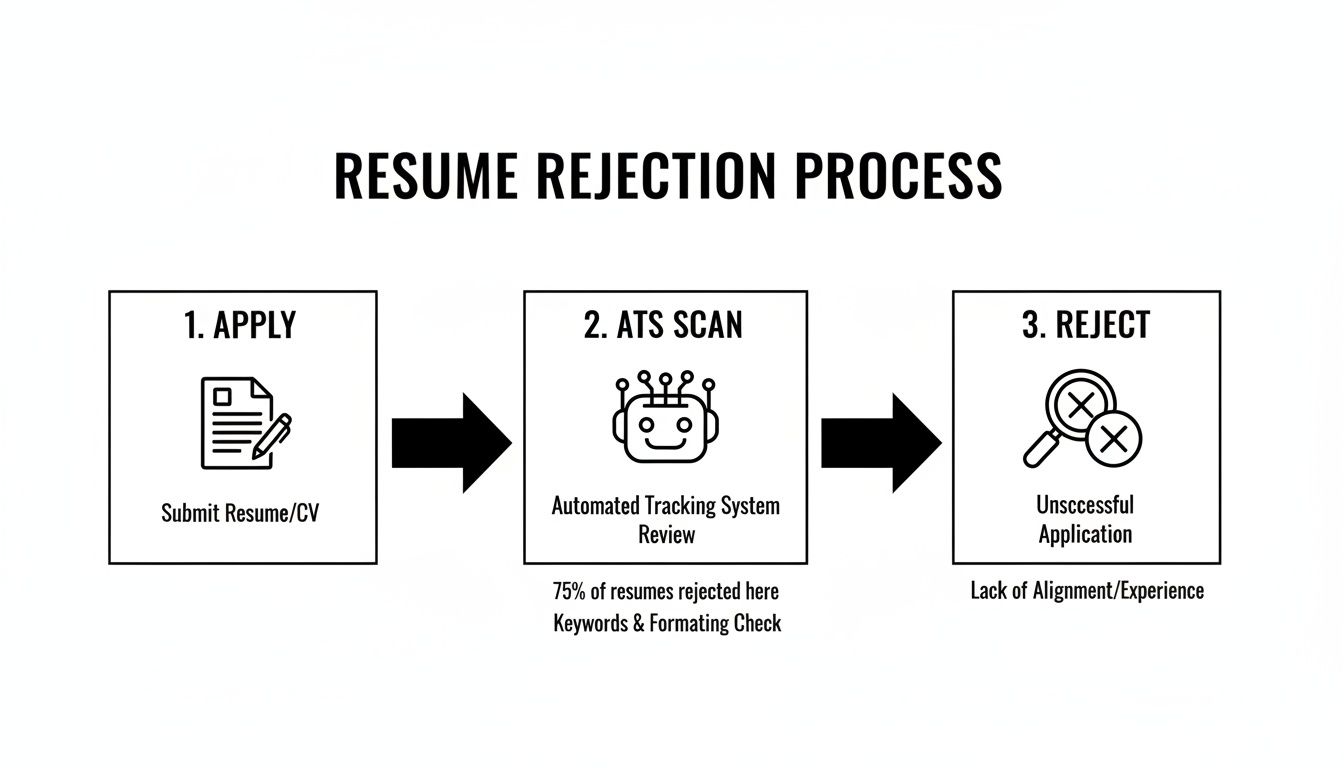
The biggest hurdle by far is that initial ATS scan. It’s a pass/fail test, and most applications fail right there.
Spotting the Different Types of Keywords
When you first scan a job description, all the important-sounding words can blend together. But if you look closer, they fall into a few distinct categories. Learning to tell them apart is how you build a smart resume optimization strategy.
You’ll primarily run into three types:
- Hard Skills: These are your technical, teachable, and measurable abilities. They are the non-negotiables. Think specific programming languages like Python, software platforms like Salesforce, or methodologies such as Agile.
- Soft Skills: These are the crucial interpersonal traits that define how you work. They can feel trickier to prove, but they are just as important. Look for terms like leadership, team collaboration, problem-solving, and communication.
- Company-Specific Lingo: Always keep an eye out for mentions of specific internal tools. Seeing something like "experience with Workday" or "proficiency in our internal CRM" is a golden opportunity. Including these shows you can get up to speed quickly.
To get a clearer picture of this, let's look at how these keywords differ across roles. The table below breaks down the difference between hard and soft skills you might find in a job description, helping you see how to categorize them.
Hard Skills vs Soft Skills Keyword Examples
| Keyword Category | Example from a Marketing Manager Role | Example from a Software Engineer Role |
|---|---|---|
| Hard Skills | SEO/SEM, Google Analytics, Market Research, Budget Management | Java, Python, AWS, Git, Data Structures |
| Soft Skills | Leadership, Strategic Thinking, Communication, Creativity | Problem-Solving, Collaboration, Time Management, Adaptability |
Seeing the skills laid out like this really helps clarify what needs to go where on your resume. It’s all about separating the "what you do" from the "how you do it."
My Framework for Keyword Analysis
Manually sifting through job descriptions can feel like a chore, but having a system makes all the difference. I personally use a simple table to sort every keyword I find. It forces you to be methodical and ensures you don't miss any valuable terms. For those who want to speed things up, you can also explore advanced job description analysis with AI tools.
A common mistake I see job seekers make is obsessing over hard skills. Recruiters consistently say that while hard skills get you the interview, soft skills are what get you the job. Modern ATS software is getting much better at spotting these, too.
A Real-World Example: Tearing Down a Job Post
Let's see how this works in practice. Here’s a snippet from a real "Junior Project Manager" job description:
- "The ideal candidate will assist in planning and executing projects, ensuring they are completed on time. Responsibilities include coordinating team members, tracking project milestones using Asana, and preparing status reports for stakeholders. Must have strong organizational skills and experience with Agile methodologies."
From just those few sentences, we've struck gold. Here's a quick list of what we found:
- Hard Skills:
- planning
- executing projects
- tracking project milestones
- Agile methodologies
- Tools:
- Soft Skills:
- coordinating team members
- status reports
- organizational skills
And there you have it. This curated list becomes the foundation for tailoring your resume. This hands-on process gives you incredible insight into a hiring manager's priorities—a skill that will pay off throughout your entire career.
Weaving Keywords into Your Resume Naturally

You’ve done your homework and have a master list of keywords. So, what now? The real trick is getting them into your resume without sounding like a sputtering robot. Just keyword-stuffing your document is a fast track to getting ignored by both the software and the human who eventually sees it.
Optimizing your resume for keywords is more of an art than a science. It's about naturally blending these terms into your professional story. You want to show you don't just know the buzzwords—you’ve actually put them to work.
Strategic Placement for Maximum Impact
Today’s Applicant Tracking Systems (ATS) are way smarter than their predecessors. They don't just do a simple keyword count; they analyze context. This means where a keyword shows up and how you use it makes a huge difference. Think of your resume as having a few high-value spots for these terms.
- Your Professional Summary: This is your opening pitch. It’s the perfect spot to plant 2-3 of the most important keywords to frame your entire narrative around what the company needs.
- A Dedicated Skills Section: This is the at-a-glance area for your hard skills. It lets an ATS easily tick the boxes for must-haves like "Python," "Google Analytics," or "Asana."
- Work Experience Bullet Points: This is where you make the keywords come alive. By embedding them in your accomplishments, you give concrete proof of your abilities.
I like to think of it this way: your skills section tells them what you can do, but your experience section proves how well you’ve done it. For a deeper dive on that crucial summary, check out our guide on crafting resume summaries that get you hired.
Context Is King
Just listing "PPC" isn't going to cut it. The most advanced ATS platforms—think Workday and Greenhouse—use contextual analysis. They're looking to see keywords paired with real responsibilities and, more importantly, results. That’s why a phrase like “managed a $50,000 PPC campaign” is infinitely more powerful than a lonely "PPC" in your skills list.
Modern ATS technology has moved far beyond basic keyword matching. It now looks at the context, recency, and duration of your skills. A skill you used in your current job carries much more weight than one from a position eight years ago. Basic keyword matching might bump your ATS score from 30% to 55%, but contextual optimization can push it to 80% or higher, clearing the typical 75% hurdle needed to pass.
The bottom line is this: always connect your keywords to a measurable achievement. Don't just claim a skill; show the impact you made with it.
Before and After The Optimization
Let's break this down with a real-world example. Here’s a pretty standard bullet point from a marketing coordinator’s resume.
- Before: Responsible for company social media accounts and email newsletters.
It's okay, but it’s bland. It’s a duty, not an accomplishment. Now, let’s imagine the job description we’re targeting is asking for “social media growth,” “email marketing,” and “HubSpot.”
- After: Drove social media growth by 25% across three platforms and executed targeted email marketing campaigns in HubSpot, resulting in a 15% increase in click-through rates.
See the difference? The "After" version is a powerhouse. It doesn't just jam in the keywords; it wraps them in quantifiable results. This is how you impress both the machine and the manager.
If you’re struggling to get the phrasing just right, an AI writing assistant can help polish your achievement statements to make them sound more natural and impactful.
Here’s a quick-reference table for upgrading your own bullet points:
| Bland Duty | Keyword-Rich Achievement |
|---|---|
| Handled project tasks | Coordinated Agile project management workflows, delivering projects 10% under budget. |
| Worked with customers | Managed client relationship management for 15+ key accounts, improving retention by 20%. |
| Analyzed sales data | Conducted data analysis using SQL to identify sales trends and inform Q3 strategy. |
When you focus on weaving keywords into achievement-driven statements, your resume stops being a simple list of tasks and becomes a compelling story of your professional value.
Does Keyword Optimization Actually Get Results?
All this talk about keywords and Applicant Tracking Systems (ATS) can feel a bit theoretical. But does tweaking your resume really make a difference? Let's get out of the weeds and look at the proof. This isn't about busywork; it's a specific strategy that gets you more interviews, plain and simple.
Mastering keyword optimization is what separates the job seekers who feel like they're shouting into the void from those who get calls from hiring managers. The change can be night and day. I’ve seen people go from a zero-response rate to an inbox full of interview requests—all from making smart, strategic edits to a document they already had.
It’s a repeatable process, not a magic trick. My goal here is to show you that every minute you spend tailoring your resume is an investment that pays off, often in a big way.
A Real-World Transformation
Let's look at a concrete example that really drives home the power of this approach. We followed one job seeker who was completely stuck, sending out application after application with almost no response. The initial numbers were tough to look at, but they tell a story many of us know all too well.
Before changing a thing, this candidate sent out 87 applications. The result? Just 3 interview requests. That’s a bleak 3.4% response rate, and it felt like a hopeless, full-time job with no paycheck.
Then, they shifted their strategy. Instead of sending out that same generic resume, they started meticulously optimizing it for every single role. After committing to this keyword-focused method, the same candidate applied to only 52 jobs but landed an incredible 18 interviews. This change skyrocketed their success to a 34.6% response rate.
That's a tenfold increase in interviews while applying to fewer jobs. This one shift—from playing a numbers game to a quality game—completely flipped the script on their job search.
This isn't a fluke. It's proof that the effort you put into keyword optimization isn't just some minor tweak. It's the single most powerful lever you can pull to get noticed.
What Recruiters Are Really Looking For
It’s easy to get caught up thinking this is all about fooling a robot, but what about the humans on the other side? Do recruiters and hiring managers even notice this stuff?
The answer is a huge yes.
Your work tailoring your resume doesn't just get seen; it's highly valued by the people who make the hiring decisions. Research shows that 83% of recruiters are more likely to move forward with candidates who have customized their resumes for the job. You can dig into more of the data behind effective ATS keyword strategies on Resilio Partners.
This stat is so important because it confirms that keyword optimization works on two levels:
- First, it gets you past the machine. A well-optimized resume clears the initial ATS filter, making sure your application actually gets seen by a person.
- Second, it impresses that person. A tailored resume is a dead giveaway that you’ve done your homework. It tells a recruiter you’ve read their job description, understand what they need, and are genuinely interested in this role, not just any role.
It’s a one-two punch that separates the candidates who get interviews from those who get ignored. Think about what a recruiter sees when a generic resume lands next to an optimized one.
| Generic Resume | Optimized Resume |
|---|---|
| Uses vague, general language. | Uses specific keywords from the job ad. |
| Simply lists past duties. | Highlights quantifiable achievements. |
| Has a one-size-fits-all summary. | Includes a targeted summary addressing the company's needs. |
| Looks like a mass application. | Shows genuine interest and real effort. |
Ultimately, taking the time to optimize your resume doesn't just improve your chances—it transforms them. It proves you're a serious, detail-oriented candidate before you even say a word.
Common Resume Optimization Mistakes and How to Fix Them
Knowing how to sprinkle the right keywords into your resume is a game-changer. But I've seen countless promising candidates torpedo their own chances with a few common, avoidable mistakes. All that hard work optimizing your resume can be undone in an instant.
Think of this as your field guide to sidestepping the traps that most job seekers fall into. Getting past the Applicant Tracking System (ATS) is only the first gate. You still have to impress the actual human who reads your resume next, and avoiding these errors is key to winning them both over.
The Problem With Keyword Stuffing
The most frequent misstep I see is "keyword stuffing." This is when someone crams their resume with as many keywords as they can, often in a clunky, unnatural way. You might see a skills section that reads: "project management, project coordinator, project lead, project planning." It’s a dead giveaway.
Sure, it might feel like a clever way to check all the boxes, but this tactic almost always backfires. Modern ATS programs are smart enough to recognize this kind of repetition as spam. Worse, it makes your resume a nightmare for a hiring manager to read. Instead of seeing a qualified professional, they see a desperate attempt to game the system.
The goal is to weave keywords into the story of your accomplishments. A truly optimized resume uses the language from the job description to sound more compelling and professional, not less.
Outdated Tricks and Black-Hat Tactics
In a frantic effort to beat the bots, some job seekers resort to old-school tricks they found on a forum somewhere. You might have heard about hiding keywords by changing the text color to white or shrinking the font size to 1. These tactics are completely obsolete and will do more harm than good.
ATS software reads every bit of text on the page, regardless of color or size. When it finds hidden text, it often flags the application for review or rejects it outright. Recruiters know these tricks, too. It’s an immediate red flag that makes you look dishonest before they've even had a chance to speak with you. If you want a deeper dive, check out our guide on ATS keyword mistakes that prevent your resume from getting noticed.
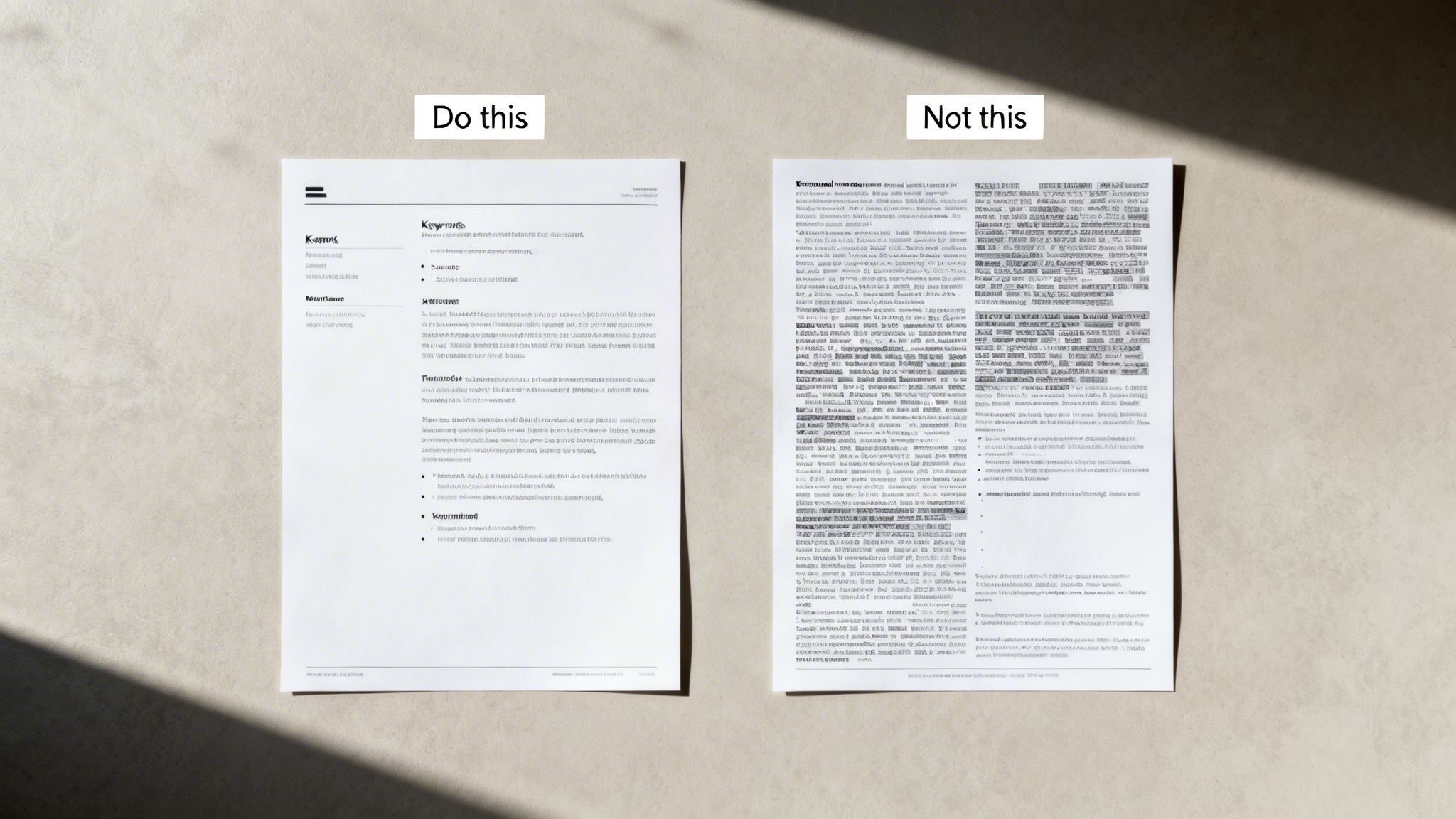
Here’s a quick cheat sheet on what to do—and what not to do—to keep your resume looking sharp and professional.
| Do This | Not That |
|---|---|
| Weave 2-3 of the most critical keywords into your achievement-based bullet points. | List the same keyword ten times in a row at the bottom of your resume. |
| Use a dedicated skills section to list your technical abilities clearly and concisely. | Hide keywords by making them white or a tiny font size. |
| Contextualize keywords by tying them to measurable results (e.g., "Increased sales by 15% using Salesforce"). | Simply list buzzwords without any proof of how you used them. |
| Focus on matching the core requirements of the job description naturally. | Copy and paste sentences directly from the job description into your resume. |
The Single Biggest Mistake You Can Make
Of all the mistakes, the most damaging one is also the most common: using one generic resume for every single job application. Sending out a one-size-fits-all document is like sending a form letter—it screams that you aren't truly interested in this company, just in landing any job.
Every job description is different. It has its own unique mix of keywords, priorities, and company-specific language. A resume that’s a 90% match for one role might only be a 40% match for another, even if the titles sound the same. Failing to customize your resume is the fastest way to get filtered out before anyone even knows you exist.
A generic resume almost always fails because it:
- Misses crucial keywords that are unique to that specific job post.
- Shows a lack of effort and genuine interest to the person reading it.
- Fails to highlight your most relevant skills for that specific role.
Taking a few extra minutes to tailor your summary, skills, and experience for each application is non-negotiable. It is the single most effective thing you can do to prove you’re the right person for the job and move on to the next round.
Getting Your Resume Keyword Questions Answered
Stepping into resume optimization can feel like you're trying to crack a code. As you start working to get your resume past the Applicant Tracking Systems (ATS), questions are bound to pop up. It’s totally normal. Let's walk through some of the most common ones I hear from job seekers.
Think of this as the inside scoop to help you move forward with confidence. Getting these fundamentals right will save you a ton of frustration and let you focus on what really matters.
How Many Keywords Should I Put in My Resume?
This is probably the most-asked question, and the honest answer is there’s no magic number. It’s all about quality and relevance over sheer quantity. Forget about hitting a specific count. Instead, your goal should be to naturally weave the most important keywords from the job description into your resume 2-3 times.
You want your resume to echo the language in the job post, but you don't want it to sound like a broken record. The best way to do this is by placing those key terms in the most visible spots:
- Your Professional Summary: This is prime real estate for the top 2-3 most critical keywords.
- The Skills Section: The perfect place to list those essential hard skills and software platforms.
- Work Experience Bullet Points: This is where you make keywords count by connecting them to your accomplishments.
A good rule of thumb is to make sure every core requirement listed in the job description shows up somewhere in your resume. A high match score from a tool just confirms you've covered your bases. To dig deeper on this, check out our guide on finding the right resume keyword density.
Will My Resume Sound Like a Robot Wrote It?
Only if you do it wrong! This is a common fear, but when you optimize your resume correctly, it should actually sound more human and impressive, not less. The trick is to stop thinking about it as "keyword stuffing" and start thinking about it as "storytelling."
A robot just lists duties; a real professional shows their impact. It's all about the context.
| Robot-Like (What to Avoid) | Human-Like (What to Do) |
|---|---|
| "Skills: Project Management, Agile, Budgets" | "Led a cross-functional team using Agile project management principles to launch a new feature 15% ahead of schedule." |
| "Responsible for data analysis and reporting." | "Conducted in-depth data analysis that identified key market trends, leading to a 10% shift in sales strategy." |
A perfectly optimized resume shouldn't sound robotic at all. It should read even better to a hiring manager because it directly addresses their specific needs using the exact language they understand and value.
When you wrap keywords inside powerful, measurable achievements, you aren't just checking a box for a machine. You're building a compelling case for your value as a professional.
Do I Really Need to Customize My Resume for Every Job?
Short answer: yes, absolutely. In today's job market, this is non-negotiable. Firing off a generic resume is one of the fastest ways to get automatically rejected.
Here's why: every company has its own unique vocabulary and priorities, even for roles with the exact same title. The specific keywords and responsibilities for a "Project Manager" at a fast-paced tech startup will be completely different from a "Project Manager" role at a huge construction firm.
Customizing your resume is the single most important thing you can do to get more interviews. It sounds like a lot of work, but this targeted approach is what separates the candidates who get callbacks from those who hear nothing back. A resume that scores an 85% match for one job might only hit 40% for another—proof that customization is everything.
Feeling exhausted just thinking about tailoring every single application? You're not alone. JobWinner was designed to solve this exact problem. Our AI platform instantly customizes your resume and cover letter for each job, analyzes your match score, and helps you prep for interviews—all in one place. Stop spinning your wheels and start landing more interviews by visiting https://jobwinner.ai today.