 EN
EN  ES
ES  IT
IT  FR
FR 
Think of your resume as a collection of essential building blocks. Each piece—your contact info, professional summary, work experience, education, and skills—works together to create a full, compelling picture of who you are as a professional.
But before we dive deep into each section, let's get a bird's-eye view of what makes up a modern, effective resume. These are the key ingredients you'll need to tell your professional story.
Key Components of a Modern Resume
This table breaks down the essential and optional sections that create a powerful, well-rounded resume. It's like a recipe for your career story.
| Resume Component | Purpose | Why It Matters |
|---|---|---|
| Header | Provides your name and contact information. | Makes it easy for recruiters to get in touch with you. |
| Summary | A 2-4 sentence "elevator pitch" of your career. | Hooks the reader and highlights your top qualifications upfront. |
| Experience | Details your work history with achievements. | Shows your direct impact and proves your capabilities. |
| Education | Lists your academic background and degrees. | Fulfills job requirements and demonstrates foundational knowledge. |
| Skills | A curated list of your technical and soft skills. | Highlights specific competencies relevant to the job. |
| Projects | Showcases specific work or personal projects. | A great way to demonstrate skills when experience is limited. |
| Certifications | Lists professional licenses or certifications. | Adds credibility and shows specialized expertise. |
Each of these components plays a crucial role, but let's start at the very top—the two sections that make or break your first impression.
1. Your Resume's First Impression: The Header and Summary
Imagine your resume is the opening scene of a movie. You've only got a few seconds to grab the recruiter's attention and make them want to see more. Your header and summary are the very first things a hiring manager sees, setting the tone for everything that follows.
Think of this first part as your personal branding powerhouse. It all starts with a crystal-clear contact header and a summary that packs a punch. It's your one shot to tell a hiring manager who you are, what problems you solve, and why you're the perfect fit—all in just a few powerful lines.
This simple diagram shows how the header and summary are the foundational elements at the top of your resume's hierarchy.
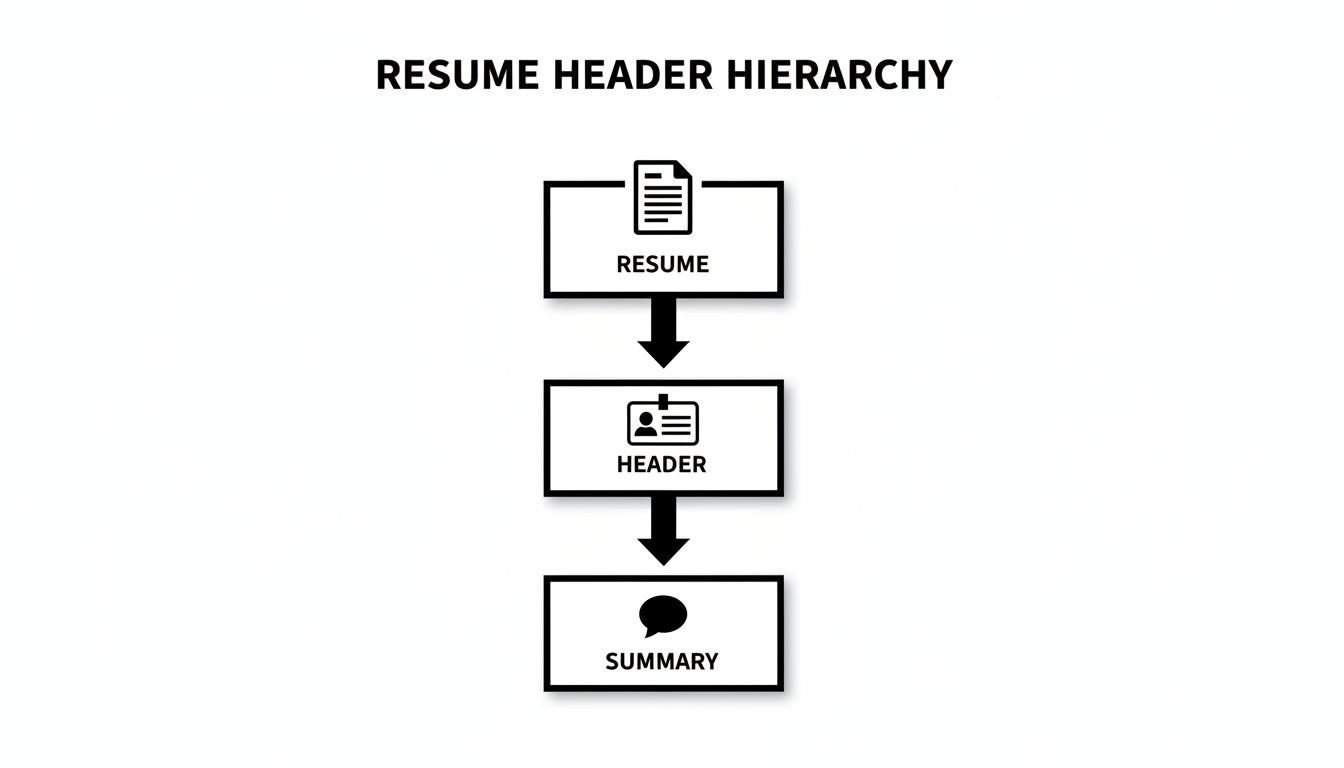
As you can see, after a recruiter identifies the document as a resume, the header and summary are their very first points of engagement. Getting them right is non-negotiable.
Crafting the Perfect Header
Your resume header is straightforward, but it's absolutely vital. This is the "who you are" and "how to reach you" part of the document. If a recruiter is impressed by what they read, they need to know how to contact you instantly, without any friction.
A clean, professional header ensures you're just a call or an email away. Make sure it includes these key pieces of information:
- Full Name: Display this prominently at the very top.
- Phone Number: Your mobile number is best.
- Professional Email Address: Stick to a simple format like
firstname.lastname@email.com. - Location: Your City and State are all you need—no full street address required.
- LinkedIn Profile URL: A customized, professional-looking URL is a fantastic touch.
Writing a Summary That Sells
Think of your resume summary as your professional elevator pitch. In just 2-4 sentences, it needs to summarize your career, highlight your top skills, and showcase your most significant achievements. This isn't just a paragraph; it’s a strategic tool designed to hook the reader and keep them reading.
Recent data confirms just how important this is: 60.7% of recruiters want to see skills and achievements highlighted right up front, and 78% look for personalization as a strong indicator of a good fit. With more employers using AI to screen candidates, a well-tailored summary is more critical than ever. You can find more insights on AI's role in hiring in this report from PR Newswire.
A powerful summary bridges your past accomplishments with the future needs of the employer. It answers the silent question every recruiter has: "Why should I hire you?"
To make your summary truly compelling, you need to weave in quantifiable achievements (think numbers and percentages) and keywords pulled directly from the job description. This simple technique makes your qualifications pop for both human recruiters and the automated screening tools they use.
Example of a Strong Summary:
Accomplished Marketing Manager with 8+ years of experience driving lead generation and brand growth for SaaS companies. Spearheaded a content marketing strategy that increased organic traffic by 150% and boosted MQLs by 40% in 12 months. Eager to leverage expertise in SEO and data analytics to drive revenue for Innovate Corp.
For a deeper dive, check out our guide on crafting resume summaries that get you hired for more detailed strategies and examples.
3. Building Your Career Story: The Work Experience Section
If your resume is a story, the work experience section is where the action happens. It’s the plot. This is where you stop making claims and start showing hard proof of what you can do. For most recruiters, this is the first place they look—it tells them everything they need to know about your career so far and what you might bring to their team.

Think of this section less as a simple list of past jobs and more as a highlight reel of your greatest hits. Your mission is to reframe your duties as compelling achievements that show you create real value.
From Duties to Achievements
The single biggest mistake people make is just listing their daily tasks. A hiring manager already has a general idea of what a "Project Manager" or "Sales Associate" does. What they don't know is how well you did it.
The trick is to connect your actions to a positive business outcome. Stop telling them what you were responsible for and start showing them what you accomplished.
Recruiters spend an average of only 7 seconds scanning a resume. Achievement-driven bullet points grab their attention immediately because they prove your value, rather than just describing your function.
This shift in mindset is what separates a resume that gets tossed from one that gets a call.
The Power of Quantifiable Results
Numbers are your best friend on a resume. They’re your secret weapon. Why? Because they provide undeniable, concrete evidence of your impact and make your achievements feel real and tangible. Vague claims are easy to gloss over, but hard numbers demand attention.
Don't just take my word for it—recent hiring statistics back this up. A massive 82.6% of recruiters say they review the work experience section first. And when they get there, 98.7% are looking for quantifiable achievements, with 32.5% scanning for them right away. You can find more of these insights in Jobseeker.com's hiring statistics report.
Here’s what that looks like in practice:
- Before: "Managed the company's social media accounts." (So what?)
- After: "Grew social media engagement by 150% over six months by implementing a new content strategy targeting key demographics." (Wow!)
The "after" version is worlds better. It tells the recruiter not just what you did, but how much of an impact you made. For a deeper dive, check out our guide on how to quantify achievements on your resume.
Formatting for Success: Reverse-Chronological Order
When it comes to organizing your work history, the gold standard is reverse-chronological order. Start with your most recent job and work your way backward. This is the format 94.5% of recruiters prefer because it gives them a clear, logical story of your career growth.
For each job you list, make sure you include these key details:
| Information | Example | Purpose |
|---|---|---|
| Job Title | Senior Marketing Manager | Clearly states your role and seniority. |
| Company Name & Location | InnovateTech, San Francisco, CA | Provides context for where you worked. |
| Dates of Employment | August 2021 – Present | Shows how long you were in the role. |
Directly under this information, use 3-5 bullet points per role to spell out your most impressive, number-driven accomplishments. This scannable structure ensures that even the busiest hiring manager can quickly see the value you bring to the table.
5. The Skills Section: Your Professional Toolbox
Think of your skills section as a snapshot of your professional toolbox. After a hiring manager gets the story of your career from the experience section, this is where they look to see the specific tools you used to make it all happen. This isn’t just a random list of keywords; it’s your chance to prove you have the exact abilities they’re looking for right now.
These days, recruiters want to see a healthy mix of two kinds of skills:
- Hard Skills: These are the concrete, teachable abilities you’ve learned. We're talking about things like programming languages, design software, or fluency in Spanish. They're specific and measurable.
- Soft Skills: These are your interpersonal traits—how you work and connect with others. Think communication, leadership, and creative problem-solving. They’re harder to quantify but just as important.
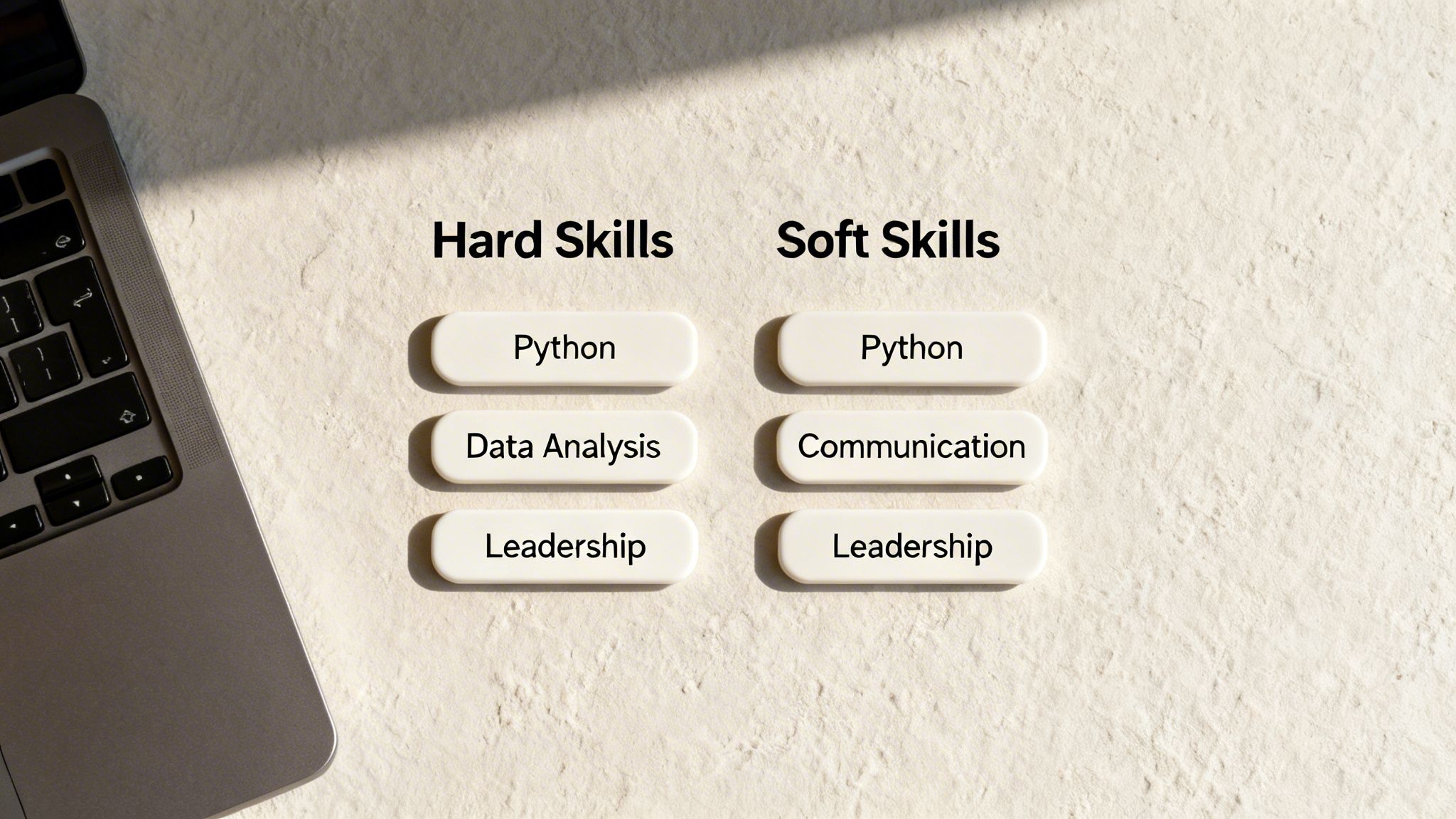
A killer skills section finds the sweet spot between these two. It shows you have the technical chops for the job and the personal qualities to be a great team member.
Tailor Your Skills to Every Job
Let me be blunt: a generic, one-size-fits-all skills list is a waste of space. The only way to make this section work for you is to customize it for every single job you apply for. Your mission is to mirror the language in the job description, making it obvious to the hiring manager that you’re a perfect match.
Start by dissecting the job posting. What skills do they mention over and over? Those are your non-negotiables. If they repeatedly call out "data visualization," "agile methodologies," and "stakeholder communication," those three skills better be front and center on your resume.
A well-curated skills section is a powerful signal to both the Applicant Tracking System (ATS) and the human recruiter on the other side. It says, "I've read your job post carefully, and I have exactly what you need."
This simple act of tailoring shows you're detail-oriented and genuinely interested in this specific role, not just blasting out applications.
Organize Your Skills for a Quick Scan
How you arrange your skills matters almost as much as what you list. A chaotic, jumbled block of text is an instant turn-off for a busy recruiter. The key is to group your skills into logical, scannable categories.
Here’s a simple, effective way to structure this section:
| Skill Category | Example Skills | Why This Format Works |
|---|---|---|
| Technical Skills | Python, SQL, Tableau, Google Analytics | Bundles your specific software and programming knowledge. |
| Marketing Skills | SEO, SEM, Content Strategy, Email Marketing | Highlights your expertise in a specific professional field. |
| Soft Skills | Leadership, Team Collaboration, Problem-Solving | Showcases your valuable interpersonal and professional qualities. |
| Languages | English (Native), Spanish (Professional Fluency) | Clearly communicates your linguistic abilities. |
This organized format lets a recruiter find what they’re looking for in seconds. If you're not sure which skills are most relevant in today's market, it's always a good idea to research the most in-demand essential resume skills for professionals in your field.
Don’t underestimate the power of a balanced skill set. While 88% of hiring managers prioritize hard skills, 48% specifically look for a resume that shows a good mix of both technical and soft skills. Including sought-after abilities like problem-solving (89%) and teamwork (80%) is a must. If you need more help getting this section just right, our guide shows you how to write a resume skills section step by step.
Validating Your Expertise With Education And Certifications
Your work history paints a picture of where you’ve been; your education explains how you got there. Think of your degree as the bedrock under a skyscraper—without it, the whole structure wobbles. Depending on where you are in your career, you’ll shift this section’s placement to make the strongest impact.
How To Format Your Education Section
Be clear. Be concise. Recruiters often skim a resume in 6–7 seconds, so clutter has no place here. A consistent layout and straightforward headings help them zero in on what matters.
| Experience Level | Key Information To Include | Formatting Tip |
|---|---|---|
| Recent Graduate | Degree, University, Graduation Date, GPA (if 3.5 or higher), Relevant Coursework, Academic Honors. | Position this right after your summary to shine a light on academic wins. |
| Experienced Professional | Degree, University, Graduation Date. | Tuck it below your work history and skip GPA or coursework details. |
With this setup, your academic background remains front and center—whether you’re launching your career or steering complex projects.
Showcasing Lifelong Learning With Certifications
Modern employers prize proof that you’re actively refining your skill set. Certifications act like tune-ups for your expertise, signaling that you don’t just rest on past achievements.
Think of certifications as proof of your specialized expertise. They show you’ve gone the extra mile to master a specific tool, methodology, or skill set, which can give you a significant competitive edge.
From vendor-led workshops to online bootcamps, any credential that fills a gap deserves its own spotlight. Placing them in a dedicated section ensures they don’t blend into the rest of your resume. Here’s an example layout of a dedicated certifications list:
- Project Management Professional (PMP) – Project Management Institute, 2022
- Certified Information Systems Security Professional (CISSP) – (ISC)², 2021
- Google Analytics Individual Qualification (GAIQ) – Google, 2023
This organized approach highlights both your foundational education and your appetite for new challenges.
Using Optional Sections to Tell a Fuller Story
Once you've nailed down the essential parts of your resume, it's time to think about what else you can add. This is where optional sections come in, and they can be a real secret weapon for making you stand out. Think of the core sections as the main plot of a movie; these optional sections are the compelling subplots that add depth, personality, and context.
These extra details can give your resume a serious competitive edge by painting a more complete picture of who you are. Here's a quick rundown of some powerful optional sections:
- Projects Section: A game-changer for developers, designers, or anyone whose work is better shown than told. It’s tangible proof of your skills.
- Volunteer Experience: Can powerfully highlight your leadership abilities and community spirit, which is especially useful if you're changing careers or have a few gaps in your work history.
- Languages: Essential for roles in global companies or diverse communities.

Choosing the Right Sections For You
Here’s the thing: you don’t need to add every possible section. The trick is to be strategic. Only choose additions that directly back up your career goals and match what your target industry values.
Your resume is a marketing document, and every square inch of it should be working to sell you as the best candidate. Optional sections are your chance to add compelling evidence that your competitors might be missing.
Think about which of these extras could tip the scales in your favor. A well-chosen section might just be the one detail that convinces a hiring manager to move your resume to the "interview" pile.
To help you decide, here’s a quick guide on which optional sections pack the most punch and when to use them.
Optional Resume Sections: When to Use Them
| Optional Section | Best For | Example |
|---|---|---|
| Projects | Tech professionals, designers, freelancers, and recent graduates. | "Developed a full-stack e-commerce app using React and Node.js, resulting in a 15% faster checkout process." |
| Volunteer Work | Career changers, students, or anyone with employment gaps. | "Led a team of 10 volunteers for a local food drive, increasing donations by 40% year-over-year." |
| Languages | Candidates for global companies or roles in diverse communities. | "English (Native), Spanish (Professional Working Proficiency), Mandarin (Conversational)." |
| Publications | Academics, researchers, writers, and industry experts. | "Published an article on machine learning trends in the Journal of Tech Innovation (2023)." |
Ultimately, these sections help you go beyond being just a list of jobs and skills. They build a narrative, showing your drive, your passions, and the unique value you bring to the table.
Common Questions About Resume Components
Building a resume can feel like you're trying to solve a puzzle with a bunch of pieces that don't quite fit. It's totally normal to have questions pop up along the way. Getting those questions answered is what separates a resume that gets a callback from one that gets lost in the pile.
Let's walk through some of the most common questions that trip people up, so you can build every part of your resume with confidence.
How Long Should My Resume Be?
I always tell people to stick to this rule of thumb: one page for every 10 years of experience. If you’re just starting out or have less than a decade under your belt, a sharp, focused one-page resume is your best friend. It shows you can be concise and respect a recruiter’s time.
Now, if you're a seasoned pro with a long, relevant career, stretching to two pages is completely fine. The real goal isn't about hitting a specific page count; it's about making sure every single word earns its spot. But please, never go over two pages.
Should I Include a Photo on My Resume?
This one is all about location, location, location. In the United States, Canada, and the UK, the answer is a hard no. Including a photo can open the door to unconscious bias, and many companies have policies against it to ensure fair hiring. It's just not worth the risk.
On the other hand, a professional headshot is standard practice in many countries across Europe and Asia. As you're deciding on these details, you might also wonder how hiring managers view other modern trends, for instance, do recruiters recognize AI headshots and what kind of impression they make? Your best bet is always to research the local customs for the specific region you're applying to.
How Do I Tailor My Resume for Each Job?
Let me be blunt: customizing your resume for every single application isn't just a suggestion—it's non-negotiable. It sounds like a lot of work, but it’s simpler than you think and massively boosts your odds.
Start by tearing apart the job description. Hunt for the keywords they use for skills, tools, and responsibilities. Then, weave those keywords into the key parts of your resume:
- Your Summary: Rewrite it to mirror the company's language and speak directly to their biggest needs.
- Your Experience: Reframe your bullet points to spotlight achievements that match the goals of this specific role.
- Your Skills: Make sure the software, tools, and certifications they mention are listed.
When you do this, you’re not just sending a resume; you're sending a direct answer to their problem. You become the obvious choice.
What Are the Biggest Mistakes to Avoid?
Honestly, the mistakes that sink the most resumes are usually the easiest to fix. Typos and grammar errors are killers. They scream "lack of attention to detail" and can get an otherwise great resume tossed in the trash within seconds.
A polished resume is tangible evidence of your commitment and attention to detail. Small errors can cast a large shadow on your professionalism, undermining all the hard work you've put into your experience and skills sections.
Here are a few other major blunders I see all the time:
| Mistake | Why It's a Problem | How to Fix It |
|---|---|---|
| Sending a Generic Resume | It shows you're just firing off applications and aren't truly interested. | Customize keywords and achievements for every single job. |
| Using Passive Language | Phrases like "was responsible for" sound weak and uninspired. | Use strong action verbs to show your direct impact (e.g., "managed," "created," "grew"). |
| Focusing on Duties | This just lists what you were supposed to do, not how well you did it. | Frame your accomplishments with numbers and results. Show your value. |
Ready to stop guessing and start winning? JobWinner uses AI to instantly tailor every component of your resume for the job you want. Generate ATS-friendly resumes, create compelling cover letters, and track your applications—all in one place. Try it now and see how much faster you can land interviews. Get started with JobWinner today!