 EN
EN  ES
ES  IT
IT  FR
FR 
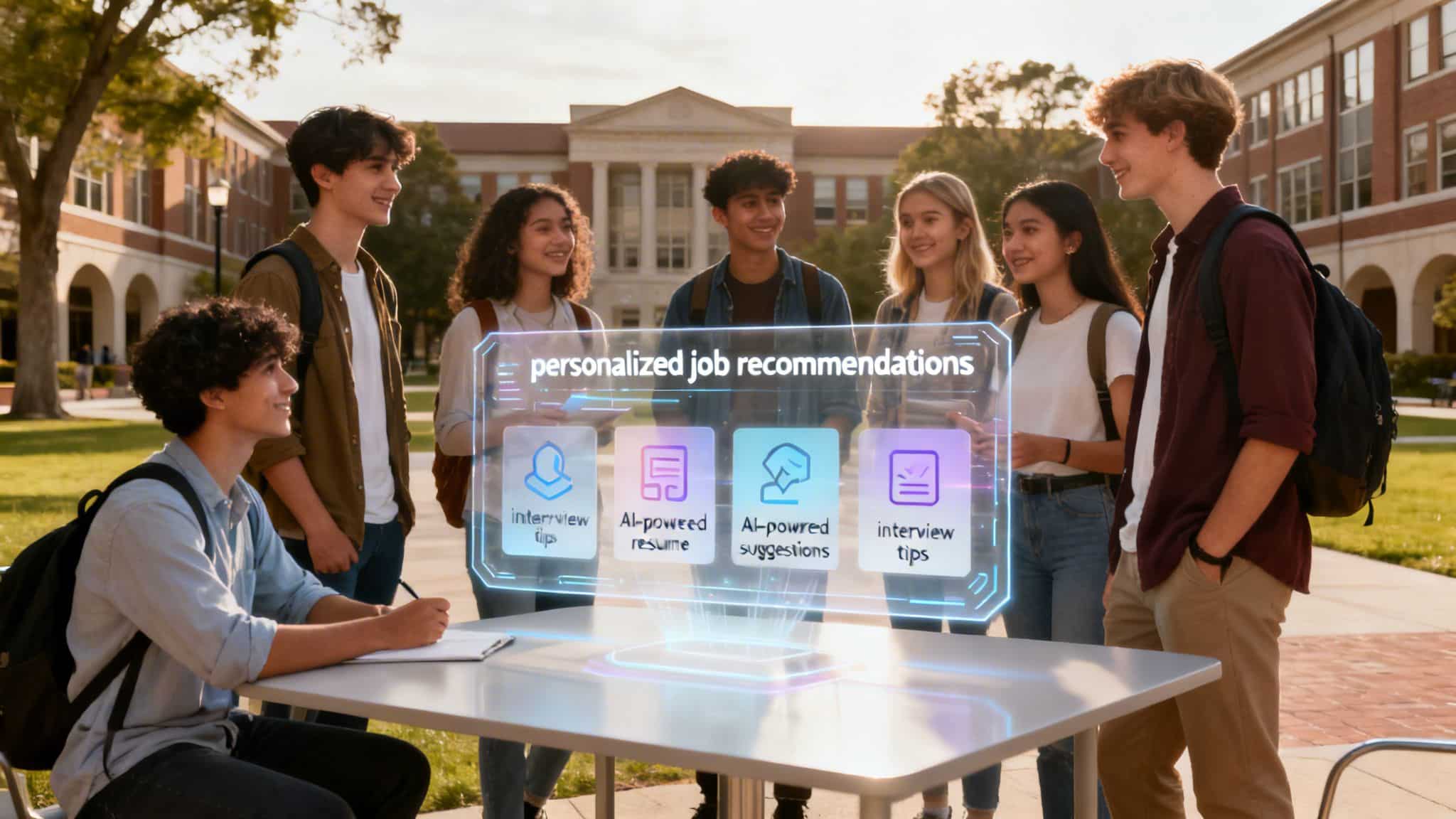
When we talk about using AI for employability programs, we're really just talking about using smart technology to give you a serious edge in your job search. Imagine having a personal career coach who works 24/7 to tailor your resume, write compelling cover letters, and even prep you for tricky interview questions. This isn't science fiction anymore—it's what it takes to get hired in 2026.
How AI Is Redefining the Modern Job Hunt
The job market has fundamentally changed, and artificial intelligence is at the heart of it all. For years, we heard predictions about AI, but now it’s actively changing the skills companies are looking for and the tools you need to stand out. The entire hiring process has shifted to favor people who don't just know about AI, but can actually put it to work.
This is a huge opportunity. Getting a job is no longer just about your past experience or who you know. It's about how well you can play the new game. Using AI for employability programs is like having a secret map for a complicated city—it helps you bypass the frustrating traffic jams caused by resume-screening software and takes you straight to the hiring manager’s desk.

The AI Skills Gap Is Your Advantage
There's a massive talent shortage happening right now, but it’s probably not what you think. A 2026 ManpowerGroup survey of 39,000 employers found that AI-related skills are now the hardest to find. In fact, a stunning 72% of companies reported that they're struggling to hire, with specific needs like AI model development (20%) and general AI literacy (19%) topping their wish lists.
This isn't a roadblock for you; it's a golden ticket. Companies are practically desperate for candidates who can help them close this gap. For you, this opens up two clear paths:
- Become an AI Specialist: Go deep into the technical side with skills in AI development, data science, or machine learning.
- Become an AI-Augmented Professional: Learn to apply AI tools and concepts in your current field, whether it's marketing, finance, or human resources.
The second path is where platforms like JobWinner really shine. They give you the power to become an AI-augmented professional without writing a single line of code, making you instantly more attractive to employers.
From Hiring to Onboarding
AI's role doesn't just stop once you get the offer. Companies are weaving artificial intelligence into every part of an employee's time with them. For example, it's becoming more common for new hires to get up to speed with help from an AI onboarding assistant.
This points to a bigger picture: businesses want to hire people who are already comfortable working alongside AI. When you use a tool like JobWinner in your search, you aren't just finding a job—you're proving you have the exact AI-readiness that companies are paying a premium for.
Understanding the AI Revolution in Hiring
Let's be honest: the headlines about artificial intelligence in the workplace can feel a little scary. They often paint a picture of extremes—either a future where robots have taken every job or a perfect world where AI has solved every problem.
The reality, as it almost always is, sits somewhere in the middle. AI is absolutely changing the job market, but not just by cutting roles. It’s actually creating new ones even faster.
The trick is to stop thinking of AI as a replacement and start seeing it as a powerful partner. Think about when the calculator was invented. It didn’t put mathematicians out of business; it simply took over the tedious manual work, freeing them up to tackle more complex and creative problems. In the same way, AI for employability programs are built to work with your skills, not make them obsolete.
This shift is creating a huge demand for people who know how to work with intelligent systems. Companies are actively searching for professionals who can manage AI tools, interpret the data they provide, and use those insights to make smart decisions. This is the new landscape of work, and it’s wide open for anyone willing to adapt.
The Real Numbers Behind AI Job Growth
The story of mass job loss due to AI is only half the picture. A much more optimistic—and data-backed—reality is taking shape. Let's look at the projections from the World Economic Forum.
Their report on the future of jobs gives us a clear look at what to expect by 2030. While some roles will be phased out by automation, the growth in new jobs created by AI is set to outpace the losses significantly.
AI's Impact on the Job Market by 2030
| Metric | Projected Number (Worldwide) |
|---|---|
| Jobs Displaced by Automation | 92 Million |
| New Jobs Created by AI | 170 Million |
| Net Job Gain | 78 Million |
This data points to a hopeful future. The "AI revolution" looks less like a crisis and more like a great reshuffling of roles and skills. The challenge isn't a shortage of jobs; it's a need for people to learn new things.
Where the New Opportunities Are
So, where exactly will these 78 million net new jobs come from? They’re popping up in fields that thrive on human-AI collaboration. Knowing where these high-growth areas are is the first step toward building a successful career in the coming years.
Here are some of the fastest-growing fields:
- Technology and Data Science: This one’s no surprise. Roles like AI Specialists, Machine Learning Engineers, and Data Analysts are in incredibly high demand.
- Healthcare: AI is helping doctors spot diseases earlier and create personalized treatments. This creates a need for Health Informatics Specialists and medical staff who are comfortable using new tech.
- Education: Personalized learning platforms are on the rise, and they require educators who can use AI tools to adapt lessons to each student's needs.
- Green Economy: AI is key to optimizing energy grids and developing sustainable technology, which is opening up a wave of "green jobs" that blend environmental science with tech skills.
The common thread is clear: the future belongs to those who can bridge the gap between human expertise and machine intelligence. The goal of AI for employability programs is to equip you with the tools and knowledge to become that bridge.
Many of these new roles involve working with the same kinds of technology that companies use to hire people, like Applicant Tracking Systems. You can read our guide on what an Applicant Tracking System is to get a better handle on the software your resume needs to impress. By embracing AI now, you’re not just preparing for the future of work—you’re positioning yourself for the biggest career opportunities of the next decade.
Bridging Your Personal Skills Gap with AI
So, you’ve pinpointed the gap between the skills you have and the skills your dream job requires. That's the easy part. The real work is building a bridge over that gap, especially when the job market seems to change every other week. This is where getting smart about AI can be your secret weapon—not just for learning new things, but for showing recruiters you’re the real deal.
It’s not just about having skills anymore; it’s about having the right ones. And right now, skills related to AI don't just make you a more interesting candidate—they often come with a bigger paycheck.
AI Literacy Is Your New Superpower
Don't worry, you don’t need to become a machine learning engineer overnight. One of the most valuable skills you can have in 2026 is simply "AI Literacy." It just means you understand what AI is, know how to use AI tools to get your job done better, and can talk intelligently about how it’s shaking up your industry.
Think of it like learning your way around a powerful new software.
- A graphic designer who masters Photoshop has a clear edge.
- A project manager who learns to use AI-powered scheduling tools gets the same kind of advantage.
This knowledge is what turns you into an "AI-augmented" professional, and companies are scrambling to find people like that.
A solid grasp of AI concepts and tools sends a clear signal to employers: you're adaptable, you think about the future, and you’re ready to help them hit their goals. It tells them they won’t have to spend a ton of time and money just getting you up to speed.
The Real-World Value of AI Skills and Certifications
Adding AI skills to your toolkit has a direct, measurable effect on your career. The data shows that these skills significantly increase your chances of getting a callback, even for applicants who have historically faced more hurdles in the hiring process. Better yet, employees who can prove they have AI skills often earn a 10-15% wage premium because demand is just that high.
And this isn't slowing down. A recent report found that a staggering 76% of American professionals are planning to learn new AI skills. Of those, 40% want to get better at their current job, while 36% are focused on making themselves more marketable for new opportunities. You can see the full breakdown and how people are getting prepared by exploring the full AI skills report from Workera.
A great way to jump on this trend is by earning certifications in AI tools that are relevant to your field. They offer concrete proof of your abilities, which can be a game-changer if you don't have a traditional four-year degree.
- For Marketers: Look into a certification for an AI-driven analytics tool like Google Analytics 4 or a platform like HubSpot's AI features.
- For Project Managers: Get certified in project management software that uses AI to automate schedules and manage resources.
- For HR Professionals: Seek out training on AI tools for recruiting, talent analytics, or employee engagement.
These credentials are your proof. They show you have the exact skills employers are looking for. For a more detailed guide on finding these gaps, take a look at our walkthrough on how to conduct a personal skills gap analysis.
How to Reposition Your Career with AI
Once you’ve got these skills, you have to show them off the right way. Just dropping a certification into the "Education" section of your resume isn’t going to cut it. You need to weave your new expertise into the story of your career.
Let's say you're a marketing manager looking to pivot into a role that's more focused on data. Instead of just being a "Marketing Manager," you could start branding yourself as a "Marketing AI Specialist."
Here’s a quick look at how you could reframe your experience to highlight your new AI chops:
| Original Experience | AI-Enhanced Experience |
|---|---|
| Managed social media campaigns. | Optimized social media ad spend by 25% using AI-powered predictive analytics to identify high-intent audiences. |
| Wrote blog posts and emails. | Increased email open rates by 15% by using generative AI to craft personalized subject lines and A/B test content. |
| Analyzed campaign performance. | Developed data-driven marketing strategies by interpreting AI-generated reports on customer behavior and market trends. |
See the difference? This approach does two brilliant things at once. First, it packs your resume with the keywords that Applicant Tracking Systems (ATS) are searching for. Second, and more importantly, it proves to a hiring manager that you don’t just know about AI—you know how to use it to deliver tangible results.
This is exactly what tools like JobWinner are designed for. It helps you analyze the job description and rephrase your accomplishments to match what the employer is looking for, making sure your new skills get the spotlight they deserve.
Your Guide to Using an AI Employability Platform
Alright, let's move from just talking about ai for employability programs to actually using one to land a job. It's one thing to understand that these tools exist; it’s another to make them work for you. We'll go through how a platform like JobWinner can make your job search faster, smarter, and a whole lot less painful.
Think of it as your own personal career co-pilot. Instead of you grinding away on every single application manually, the system handles the most tedious parts. Let's break down how you can put it to work.
Step 1: Build Your Core Profile
First things first, you need to give the AI a strong foundation to work with. This isn't just about dragging and dropping that dusty resume you have saved somewhere. It’s about building a master profile that tells your complete professional story.
Spend some real time here. Your profile should include:
- Work History: Don't just list titles. Detail what you were responsible for and, more importantly, what you achieved.
- Education: Go beyond the degree. Add your certifications and any specific coursework that’s relevant to your target career.
- Skills: Be thorough. Include a healthy mix of hard skills (like Python, SEO, or financial modeling) and soft skills (like leadership, problem-solving, or communication).
- Projects: This is your chance to shine. Add personal, academic, or professional projects that truly show what you can do.
This central profile becomes the single, reliable source the AI draws from for everything else. The more detail you provide now, the better the AI can find the perfect points to highlight for any job you apply to.
Step 2: Analyze Job Matches and Find Hidden Gems
With your profile ready to go, the real fun begins. It's time to start sizing up job descriptions, but with a major advantage. Instead of you squinting at a long job post, trying to guess what the hiring manager really wants, the platform does the heavy lifting.
JobWinner’s job match analysis instantly stacks your profile against any job description and spits out a match score. This gives you a quick, honest look at how well your experience lines up. Even better, it pinpoints the exact skills or experience you might be missing.
This feature is a game-changer for deciding where to invest your time. A high score? That's a green light to apply right away. A lower score might tell you the role isn’t a great fit, or it might just show you where you need to reframe your experience to better match what they’re looking for. This concept of using AI for self-assessment is becoming more common, much like how students now use AI mock score systems for test preparation to find and fix weak spots before a big exam.
Step 3: Automate Applications with AI
This is where you'll feel the biggest impact on your time. Once you have your core profile and a job you want to target, the AI can generate a custom-fit resume and cover letter in seconds. It intelligently selects your most relevant skills and accomplishments and rewrites them using the keywords and language from that specific job post.
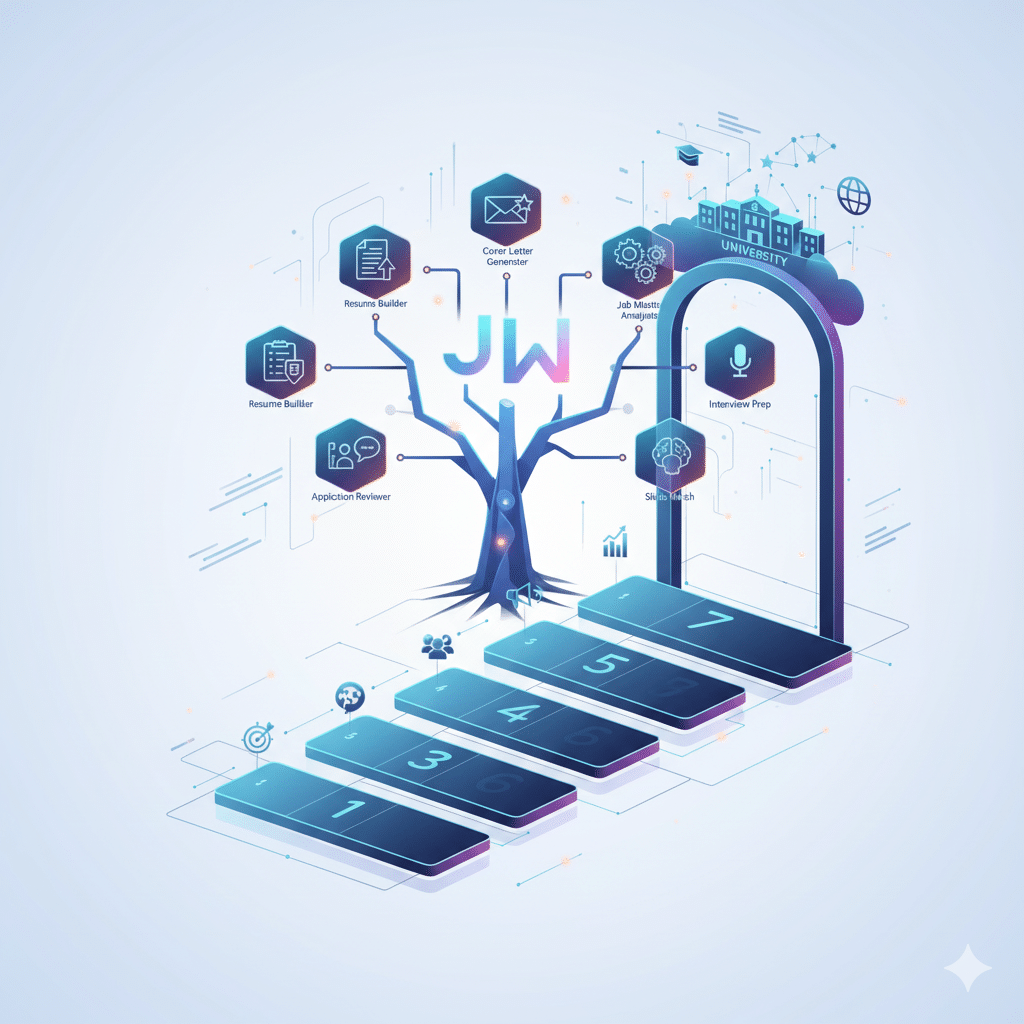
This quick infographic sums up the entire AI-powered workflow: you build a solid profile, find the best-fit jobs, and then apply with perfectly tailored documents.
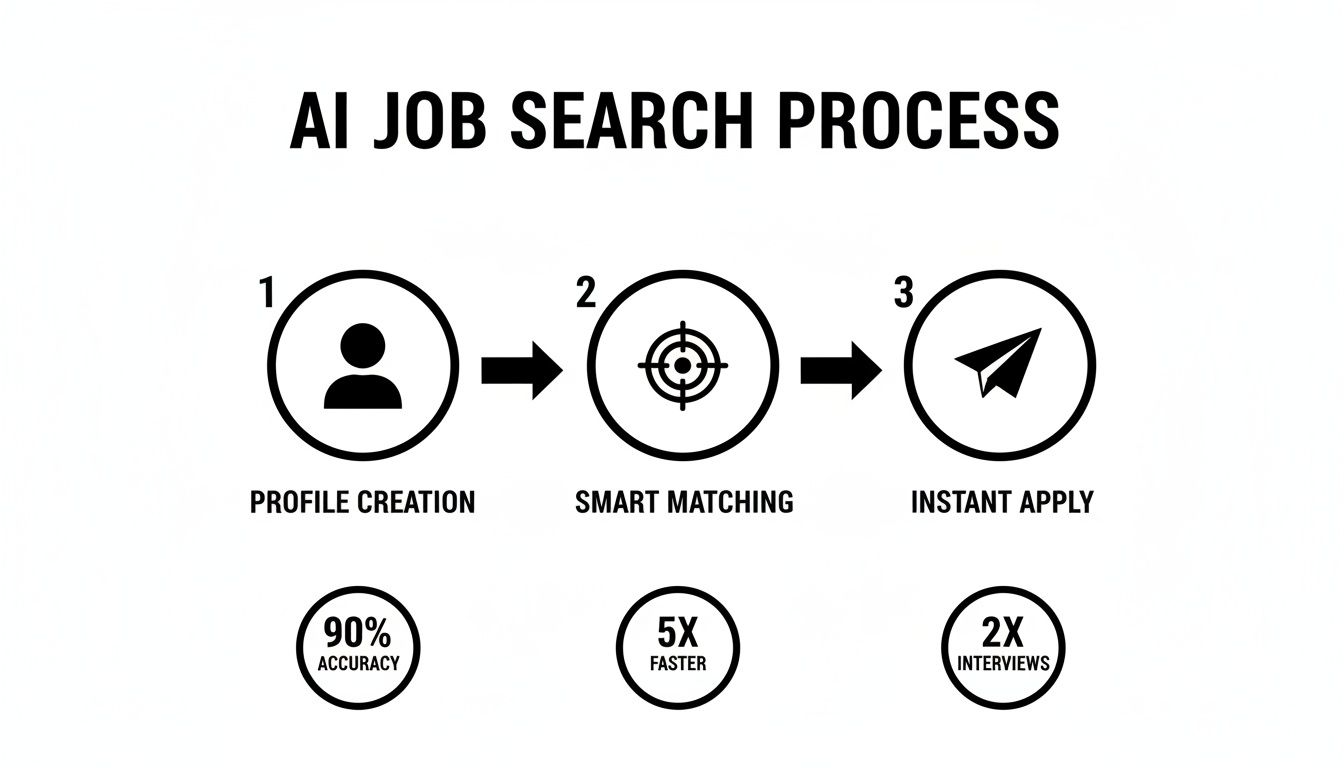
The whole point is to make sure every single application you send out is optimized for that specific role, giving you the best possible chance.
Let's see what this looks like. Imagine a project manager is applying for a job that heavily emphasizes "agile methodologies" and "stakeholder communication."
Before AI Tailoring:
"Responsible for leading project teams to complete tasks on schedule."
After AI Tailoring:
"Led cross-functional project teams using agile methodologies to ensure on-time delivery, maintaining clear stakeholder communication throughout the project lifecycle."
See the difference? The AI didn't invent anything. It simply reframed an existing point using the employer’s own language. This small tweak is what helps you get past resume-screening software (ATS) and make a great first impression on a real person. If this kind of system seems valuable, you can also learn more about how to launch a university AI career platform in our related guide.
Step 4: Practice with AI Interview Prep
Landing the interview is a huge win, but it's only half the journey. The best ai for employability programs also help you prepare to knock that interview out of the park. Tools like JobWinner offer an AI interview prep feature that looks at both the job description and your new resume to create a list of questions you're likely to be asked.
The AI doesn’t just pull generic questions from a database. It generates role-specific, behavioral, and technical questions tailored to you and the job, giving you a serious competitive edge.
It can even help you structure your answers using proven frameworks like the STAR method (Situation, Task, Action, Result). You can run through your responses, get instant feedback, and build the confidence you need to walk into the real interview feeling prepared and ready to impress. This final step brings the process full circle, helping you turn that AI-powered application into a fantastic job offer.
Crafting an Application That Stands Out With AI
So, your resume made it past the Applicant Tracking System (ATS). That’s a huge first step, but the real challenge is just beginning. Now, your application lands in front of a real person—the hiring manager—and you have a few precious seconds to make an impression. This is where AI can help you build a narrative that truly connects.
Smart AI tools in 2026 do more than just cram keywords into your resume. They can help you understand a company's culture and voice, allowing you to reflect that tone back in your application. Think of AI as your research assistant; it does the heavy lifting of analyzing the company, so you can focus on showing them why you’re the perfect fit.
Beyond Keywords to Match Company Culture
A great application doesn’t just list your qualifications; it tells a story that makes the hiring manager feel like you already belong on their team. The best tools using AI for employability programs can scan a company’s website, read its "About Us" page, and even look through social media posts to get a sense of their personality.
Is their communication style buttoned-up and corporate, or is it laid-back and full of personality? AI can identify these nuances, helping you adjust the tone of your cover letter and resume summary to match.
For example: If a company’s mission statement is all about "collaboration" and "community impact," an AI-assisted cover letter might suggest highlighting a team project where your work made a real difference. This small shift changes you from just another applicant into a candidate who truly gets what the company stands for.
Traditional vs. AI-Powered Application
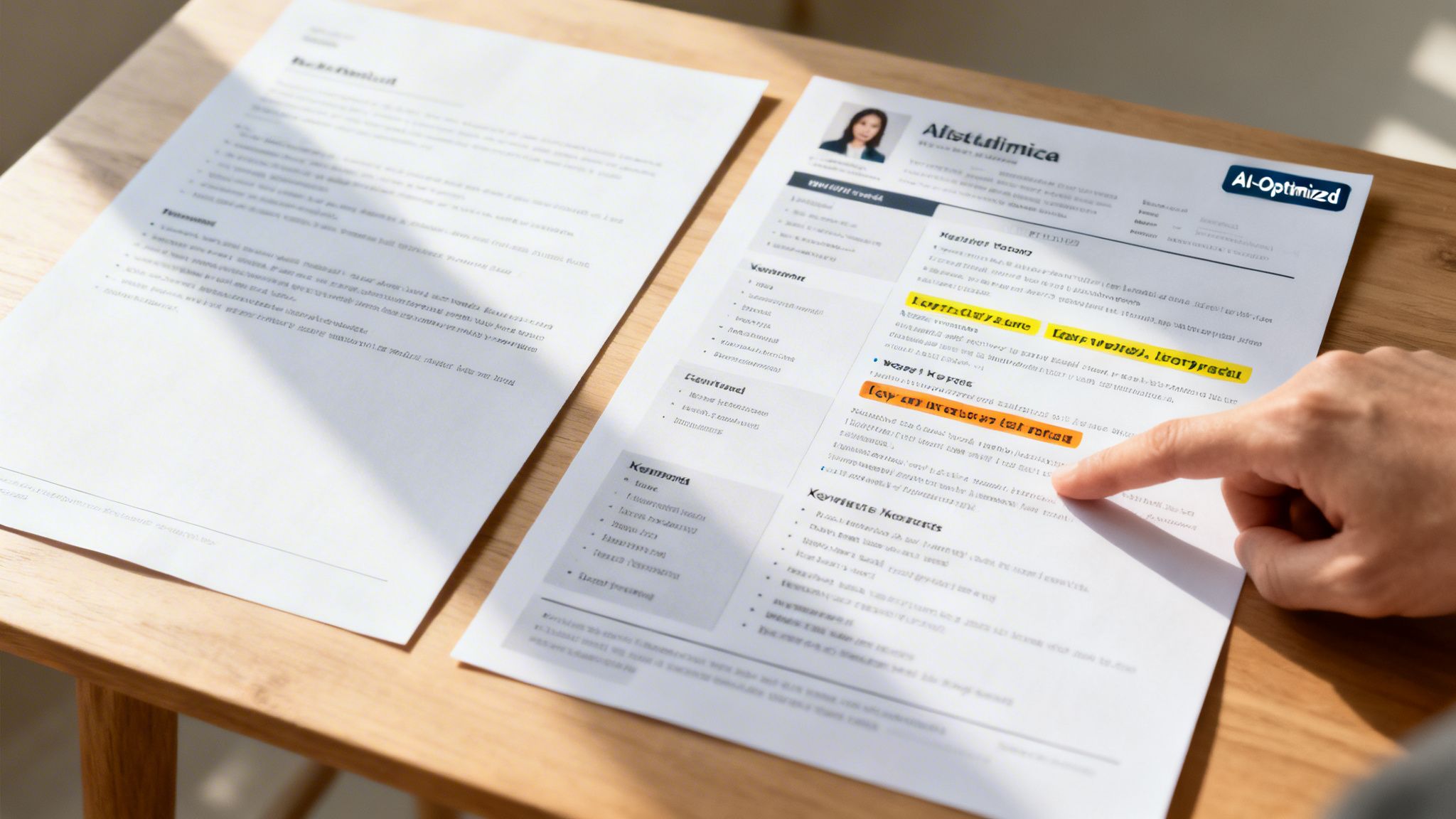
The gap between a generic, one-size-fits-all application and one fine-tuned with AI is massive. A standard resume might suggest you’re just firing off applications everywhere, but an AI-optimized one shows you've put in the effort to understand the role and the company.
The table below breaks down how a platform like JobWinner elevates each part of your application.
| Application Component | Traditional Manual Approach | AI-Powered (JobWinner) Approach |
|---|---|---|
| Resume Summary | A generic statement like, "Results-oriented professional seeking a challenging new role." | A specific summary tailored to the job, like, "Data-driven marketing specialist with 5+ years of experience in agile environments, passionate about using analytics to boost customer engagement." |
| Skill Keywords | Includes general skills like "Teamwork" and "Microsoft Office." | Strategically weaves in specific keywords from the job description, such as "SEO optimization," "content strategy," and "Salesforce." |
| Cover Letter Tone | Uses the same formal tone for every application, regardless of the company. | Adjusts the tone to match the company's voice—energetic for a startup, or more reserved and professional for a financial firm. |
| Achievements | Lists responsibilities, such as "Responsible for managing social media accounts." | Transforms duties into quantified achievements, such as "Grew social media engagement by 40% in six months by implementing a new content strategy." |
This kind of specific, tailored detail is exactly what captures a hiring manager's attention. If you want to dive deeper into this, our guide on the best AI resume builder has even more practical advice.
Avoiding Common AI Pitfalls
While AI is an incredible tool, it’s not perfect. One of the biggest mistakes you can make is relying on it completely without adding your own final review. An application that sounds too robotic or contains strange errors will do more harm than good.
Always treat AI output as a starting point—a first draft—not the final version. It's your job to review, refine, and inject your own voice and experience into the document. That human touch is what makes an application truly compelling.
Here are a few common traps to watch out for:
- Ignoring Context: An AI might suggest a keyword that fits technically but sounds clunky or unnatural in a sentence. Always read your resume and cover letter out loud to catch awkward phrasing.
- Losing Your Voice: Your application should still sound like you. Feel free to tweak the language to match your personal style while keeping the core message that the AI helped you craft.
- Overlooking Errors: AI can occasionally make grammatical mistakes or create sentences that don't quite land. A thorough proofread by a human (you!) is non-negotiable.
The real magic happens when you blend the efficiency of AI with your unique human perspective. Get that balance right, and you'll have an application that’s not only optimized for software but also genuinely impressive to the people who hold the key to your next job.
Your Questions About AI in Job Searching Answered
It's completely normal to have questions about using AI for something as personal as your job hunt. Letting a machine handle parts of your career search can feel a little strange at first. Let's walk through some of the most common concerns to help you get comfortable with these tools and see how they can work for you.
Will an AI Tool Make My Resume Sound Robotic?
That’s a big fear for a lot of people, but it’s a common misconception. Think of a good AI platform less like a robot writer and more like a brilliant co-pilot. Its job isn't to invent your experience but to make sure your resume speaks the employer's language.
The AI scans a job description for the most important skills and keywords, then suggests how to weave them into your existing accomplishments. The final product is always yours. Your voice, your achievements, your story. We always tell people to do one last read-through to add their own personal flair and make sure the tone feels just right.
Can AI Help Me If I Am Changing Careers?
Yes, absolutely. In fact, this is where these tools really shine. One of the toughest parts of a career change is figuring out how to translate your past work into a language that makes sense in a new field.
An AI tool is fantastic at spotting your transferable skills—things like leadership, budget management, or client communication—and reframing them to align with the new job you’re targeting.
Example: It can take a phrase like "managed a retail team of 10" and suggest something like "led cross-functional project execution and stakeholder management for a team of 10." The second version uses language that will instantly click with a corporate hiring manager.
It also highlights the exact skills you're missing for a particular role, giving you a clear, practical roadmap for your career transition. It makes the entire process feel much less overwhelming.
Are Paid AI Job Search Platforms Worth It?
While free tools definitely have their place, a dedicated AI platform is an investment in your two most precious assets: your time and your career opportunities. The average person can easily spend a few hours tailoring a single resume and cover letter for one job application. A platform like JobWinner can shrink that process down to just a few minutes.
Think about the return on that investment:
- Time Saved: You can apply to more of the right jobs, much faster.
- Application Quality: Every single application is fine-tuned to beat the applicant tracking systems and impress the hiring manager.
- Increased Odds: More high-quality applications directly lead to more interview callbacks.
It’s about working smarter, not harder. The goal is to shorten your job search, reduce the frustration, and help you land a better-paying role sooner. When you get hired faster, the tool has already paid for itself.
How Is My Personal Data Kept Safe?
Any reputable AI platform takes data privacy incredibly seriously. Your personal information, from your work history to your contact details, is protected with industry-standard encryption and security measures.
Your data is used for one purpose and one purpose only: to power the features that help you. This means tailoring your documents, analyzing job descriptions, and helping you prep for interviews. Reputable companies will never sell your data to other businesses. Before committing to any tool, it’s always a good idea to check its privacy policy for a clear explanation of how your information is handled. We built our platform on trust, and protecting your data is a core part of that commitment.
Ready to stop wasting time and start landing more interviews? Let JobWinner build perfectly tailored, ATS-beating resumes and cover letters in seconds. Get started with JobWinner today