 EN
EN  ES
ES  IT
IT  FR
FR 
A company announces a round of layoffs. HR contacts your firm. Within days, you are expected to support dozens, sometimes hundreds, of displaced workers through one of the most stressful transitions of their professional lives. And you are expected to do it consistently, at scale, and with measurable outcomes that justify the contract.
That pressure is not new. What is new is that the tools available to meet it have changed significantly. AI outplacement platforms are now capable of doing the heavy lifting on the most time-intensive parts of the job search process, freeing your advisors to focus on what they do best: coaching, motivating, and guiding people through uncertainty.
This guide is for outplacement firm leaders and program managers who want a clear, practical picture of how AI fits into a modern outplacement program, what to look for in a platform, and how to implement it without disrupting what already works.
What Is an AI Outplacement Platform and Why Does It Matter?
An AI outplacement platform is a software system that delivers personalized career transition support at scale. Instead of every displaced worker waiting for a one-on-one advisor session to get their resume reviewed or their interview skills assessed, the platform handles those tasks on demand, any time of day, for any number of participants simultaneously.
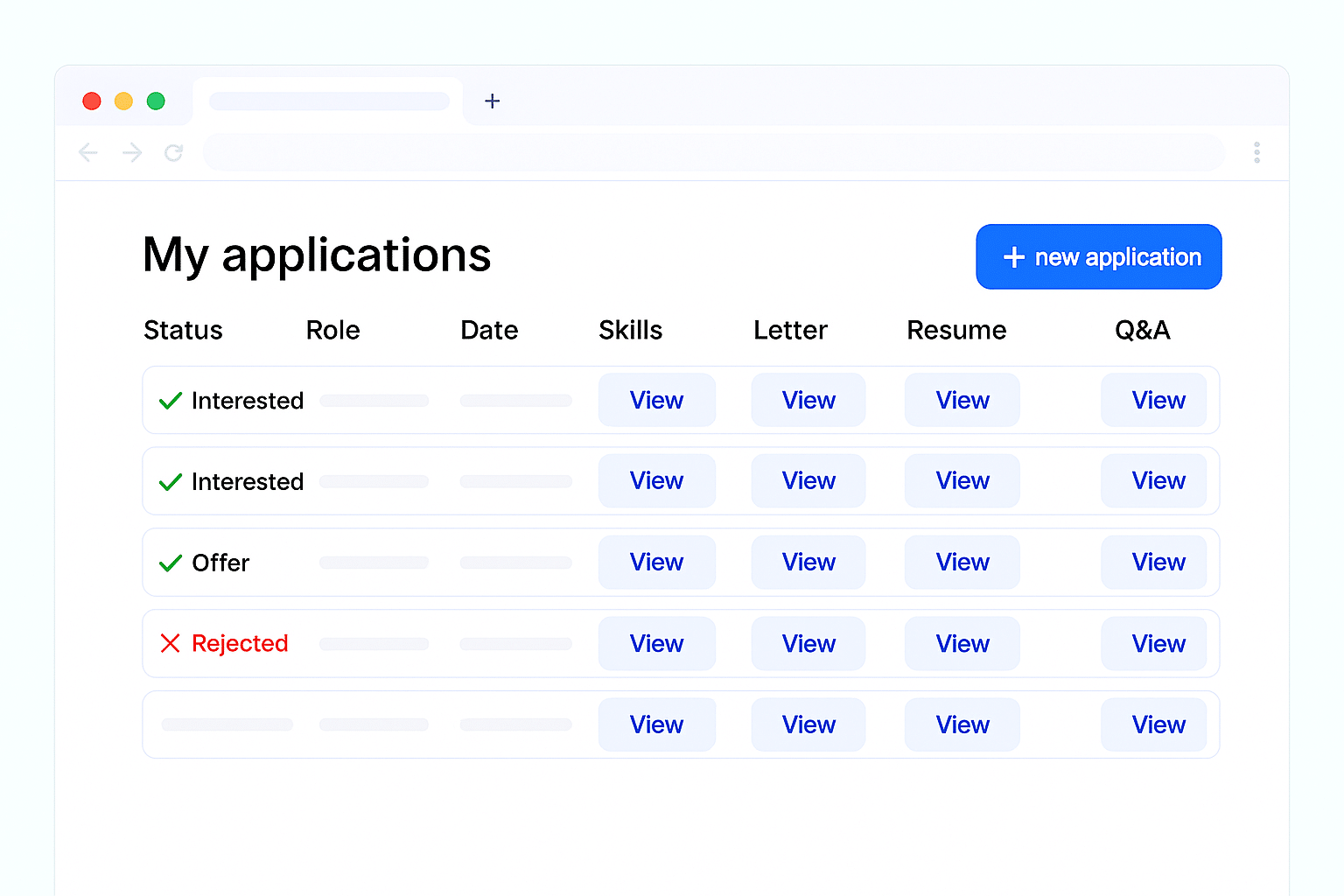
The core capabilities of a mature AI outplacement platform typically include resume tailoring to specific job descriptions, Applicant Tracking System (ATS) compatibility scoring, cover letter generation, LinkedIn profile optimization, interview preparation with simulated questions, job matching, and a dashboard for advisors to monitor participant progress across the cohort.
Why does this matter now, specifically? Three reasons.
- Layoff volumes are unpredictable. A firm that can comfortably support 50 participants with its current advisor team may get a contract for 300 with four weeks notice. AI platforms absorb that surge without requiring you to hire.
- Job seekers expect digital-first experiences. Participants who are accustomed to on-demand tools in every other area of their lives are frustrated by outplacement programs that require them to book a session days in advance to get basic resume feedback.
- Clients are demanding outcome data. HR leaders and CFOs who commission outplacement programs increasingly want to see time-to-placement metrics, engagement rates, and job offer quality data. AI platforms generate this data automatically.
Insider Tip: The firms winning the most competitive outplacement contracts right now are not necessarily the ones with the most experienced advisors. They are the ones who can show a prospective client a dashboard with real outcome data from previous programs. If your current setup cannot produce that, an AI platform is the fastest path to fixing it.
How Does AI Improve Outplacement Program Outcomes?
The honest answer is that AI improves outcomes by removing the bottlenecks that slow displaced workers down at the exact moments when momentum matters most. The first two to four weeks after a layoff are critical. Workers who engage quickly with their job search, update their materials, and start applying tend to land faster than those who stall. Traditional outplacement programs, even good ones, often create unintentional friction at this stage.
Consider the typical flow without AI. A worker receives access to the program. They are assigned an advisor. They schedule an intake session, which may be a week away. They submit their resume for review. The advisor gets back to them a few days later. By the time they have an ATS-optimized resume and a tailored cover letter for their first target role, three weeks have passed. With an AI platform, that same worker can have an ATS-scored resume, a tailored version for a specific job posting, and a generated cover letter within the first hour of logging in.
The advisor’s role shifts, not shrinks
This is worth stating clearly because it is a common concern among outplacement professionals. AI does not replace career advisors. It changes what advisors spend their time on. Instead of spending 60 percent of a session reviewing a resume line by line, the advisor can spend that time on the conversations that genuinely require human judgment: processing the emotional weight of a layoff, strategizing about a career pivot, preparing for a difficult salary negotiation, or coaching someone through imposter syndrome before a senior-level interview.
Advisors who work alongside AI platforms consistently report that their sessions feel more productive and that participants arrive better prepared. The AI handles the transactional work. The advisor handles the transformational work.
Engagement rates improve with on-demand access
One of the persistent challenges in outplacement is keeping participants engaged after the initial onboarding. Workers who are actively job searching need support at irregular hours, often late at night after applying to jobs or immediately before an interview the next morning. An AI platform that is available around the clock keeps participants engaged with the program rather than turning to generic free tools that have no connection to their advisor or their program data.
What to Look for in an AI Outplacement Platform
Not all platforms are built for the outplacement context. Some are designed primarily for individual job seekers and lack the administrative infrastructure that outplacement firms need to manage cohorts, report to clients, and maintain brand consistency. Here is what to evaluate.
| Capability | Why it matters for outplacement firms | Red flag if missing |
|---|---|---|
| Resume tailoring and ATS scoring | The single highest-impact activity for most displaced workers. Should work for any job description, any industry. | Generic templates with no job-description matching |
| Cover letter generation | Workers applying to multiple roles need tailored letters quickly. Advisors cannot write these at scale. | One-size cover letter templates only |
| Interview preparation | Simulated questions, STAR method guidance, and feedback loops keep workers sharp between advisor sessions. | Static question banks with no personalization |
| LinkedIn optimization tools | Most recruiters source candidates on LinkedIn before they ever see a resume. Profile quality matters. | No LinkedIn-specific features |
| Advisor dashboard and cohort management | Advisors need visibility into who is engaging, who is stalling, and where to focus their attention. | No admin layer; individual accounts only |
| White-label branding | Your clients hired your firm. The platform should carry your brand, not a third-party logo. | Vendor branding that cannot be removed |
| Outcome reporting | You need data to demonstrate ROI to clients and to improve your program over time. | No reporting or only basic usage stats |
If you are evaluating vendors, ask for a demo that walks through the advisor dashboard specifically, not just the participant-facing experience. The administrative layer is where most platforms reveal their limitations.
Insider Tip: Ask every vendor the same question: “Can I see a sample outcome report that I could share with a client?” If they cannot produce one in the demo, that is your answer about whether their reporting is genuinely useful or just a checkbox feature.
How to Modernize an Outplacement Program with AI: A Step-by-Step Approach
Modernizing does not mean replacing everything at once. The firms that successfully integrate AI into their outplacement programs do it in phases, starting with the highest-friction points and building from there.
Step 1: Audit your current program for time and friction
Before selecting a platform, map out where your advisors spend their time and where participants experience delays. Common findings include resume review backlogs, cover letter requests that take days to fulfill, and interview prep that only happens in scheduled sessions rather than continuously. These are the areas where AI delivers the fastest return.
Also look at your drop-off data. At what point in the program do participants become disengaged? If it is after the first two weeks, that is a signal that the initial momentum is not being sustained, and on-demand AI tools can directly address that.
Step 2: Define your non-negotiables before evaluating vendors
Every outplacement firm has specific requirements that a general-purpose career tool may not meet. Common non-negotiables include GDPR or CCPA compliance for participant data, integration with your existing CRM or case management system, the ability to support participants across multiple industries and seniority levels, and white-label branding that holds up in enterprise client environments.
Write these down before you start demos. It is easy to get distracted by a polished interface and overlook a missing compliance feature that will become a problem at contract renewal.
Step 3: Configure the platform around your program structure
A good AI outplacement platform is not a rigid product that forces your program to conform to its defaults. It should be configurable around the way your firm works. That means setting up advisor assignments, defining the onboarding sequence participants see when they first log in, customizing the job search guidance to reflect your methodology, and applying your brand consistently throughout the experience.
This configuration step is where many firms underinvest. The participants who engage most consistently are the ones who feel they are using a tool that belongs to your program, not a generic third-party app they were handed.
JobWinner’s outplacement services platform is built to be configured around your firm’s workflow, with white-label branding and an advisor dashboard that gives you visibility across your full participant cohort. If you want to see how it fits your program structure, the demo scheduling page is the right starting point.
Step 4: Run a structured pilot with one cohort
Resist the temptation to roll out the platform across all active programs simultaneously. A pilot with one cohort, ideally 20 to 50 participants, gives you the data you need to validate the approach before scaling. Define your success metrics in advance: engagement rate at day 14, number of tailored applications submitted per participant per week, and time-to-first interview are all measurable and meaningful.
Compare these against your historical baseline from traditional program delivery. The delta is your ROI story for the next client conversation.
Step 5: Train advisors on the new workflow
The biggest implementation risk is not technical. It is advisor adoption. Career advisors who have built their practice around a particular way of working may be skeptical of a platform that changes their role. The most effective training focuses not on the software features but on the shift in how sessions can be used.
Show advisors concrete examples of what participants arrive with when they have used the AI tools before a session: a resume that is already ATS-scored, a list of target roles they have identified, interview questions they have already practiced. When advisors see that the AI makes their sessions more productive rather than making them redundant, adoption follows.
Step 6: Report outcomes to clients with platform data
Once your pilot is complete and you have outcome data, use it. Build a one-page outcome summary for the sponsoring employer that shows engagement rates, application activity, time-to-placement for completed participants, and any qualitative themes from advisor notes. This is the document that wins contract renewals and referrals.
Insider Tip: The most persuasive number you can put in front of an HR leader is not your firm’s years of experience. It is the median number of days from program enrollment to first job offer for your participants. If your AI platform is generating that data, you have a competitive advantage that is very difficult for a traditional program to replicate.
What AI Handles vs. What Advisors Handle
For outplacement firm leaders who are still working through what the division of labor looks like in practice, this breakdown is a useful reference.
| Task | AI platform handles | Advisor handles |
|---|---|---|
| Resume optimization | ATS scoring, keyword gap analysis, tailoring to specific job descriptions | Strategic positioning, career narrative, reviewing AI output with participant |
| Cover letter creation | Generating tailored drafts from job description and resume | Coaching participant to personalize tone and add authentic voice |
| Interview preparation | Generating role-specific questions, STAR method prompts, practice sessions | Behavioral coaching, managing nerves, role-specific strategy |
| LinkedIn optimization | Headline suggestions, summary drafts, skills gap identification | Reviewing final profile, coaching on outreach strategy |
| Job search organization | Job tracking, application status, follow-up reminders | Prioritization coaching, target company strategy |
| Progress monitoring | Engagement dashboards, activity reports, cohort-level data | Interpreting data, identifying at-risk participants, intervening proactively |
| Emotional support | Not applicable | Entirely the advisor’s domain |
The last row is worth emphasizing. AI does not replace the human dimension of outplacement. A displaced worker who is processing grief, anger, or fear needs a person, not a chatbot. The value of AI in this context is that it handles everything else, so the person is available for that conversation.
Common Objections to AI Outplacement Platforms (And Honest Answers)
“Our clients expect a premium, high-touch experience. Won’t AI feel impersonal?”
This is the most common concern, and it is worth taking seriously. The answer depends entirely on how the platform is implemented. If participants are handed a login and left to figure it out, yes, it will feel impersonal. If the AI tools are introduced by an advisor as part of a structured onboarding, framed as resources that support the coaching relationship rather than replace it, participants experience them as an enhancement to the program, not a substitution.
Premium outplacement does not mean low technology. It means high-quality outcomes delivered through a thoughtful combination of advisor expertise and capable tools.
“What if participants just use the AI to spray applications everywhere?”
This is a legitimate concern about job search quality versus quantity. The answer is program design, not platform limitation. If your program includes guidance on targeted job search strategy, and your advisors coach participants on quality over volume, the AI tools support that approach. The platform should be configured to encourage thoughtful application activity, and advisor sessions should reinforce the strategy. The AI does the tailoring work; the advisor shapes the strategy.
“We already have a resume writing service. Why do we need an AI platform?”
A resume writing service delivers a finished document. An AI platform gives participants the ability to tailor that document to every specific job they apply to, score it against the ATS requirements of each employer, and generate a matching cover letter, all without waiting for a human to do it. Those are fundamentally different capabilities. The resume writing service and the AI platform are complementary, not competing.
Frequently Asked Questions
What is an AI outplacement platform?
An AI outplacement platform is a software system that helps outplacement firms deliver career transition support at scale. It typically includes tools for resume tailoring, ATS optimization, cover letter generation, interview preparation, and job matching. The AI handles the repetitive, time-intensive tasks so career advisors can focus on higher-value coaching conversations.
How does AI improve outplacement program outcomes?
AI improves outplacement outcomes by giving displaced workers faster access to personalized career support, regardless of advisor availability. Workers get tailored resumes, targeted job matches, and interview practice on demand. Firms that use AI platforms typically see higher engagement rates and shorter time-to-placement compared to traditional one-size-fits-all programs.
What tools do outplacement firms use to help workers find jobs faster?
Leading outplacement firms use AI-powered tools for resume tailoring to specific job descriptions, ATS compatibility checking, cover letter generation, LinkedIn profile optimization, and mock interview practice. Job tracking dashboards help workers stay organized and help advisors monitor progress across large cohorts.
How much does an AI outplacement platform cost compared to traditional outplacement?
Traditional outplacement programs can cost thousands of dollars per participant when delivered primarily through one-on-one advisor time. AI platforms reduce the per-participant cost significantly by automating the most time-intensive tasks, allowing advisors to support larger cohorts without proportional headcount increases. The exact cost varies by vendor and program scope.
How do I modernize an outplacement program with AI?
Start by auditing your current program to identify where advisors spend the most time on repetitive tasks. Then evaluate AI platforms that cover the core job search workflow: resume tailoring, ATS scoring, cover letter generation, and interview prep. Pilot with a small cohort, measure time-to-placement and engagement, and scale from there. A white-label platform lets you keep your brand while adding AI capabilities.
If you are ready to see what a modern AI outplacement platform looks like in practice, schedule a demo with the JobWinner team. We will walk you through the advisor dashboard, the participant experience, and the outcome reporting in a single session, no commitment required.