 IT
IT  EN
EN  ES
ES  FR
FR 
If you run a job board today, you’ve probably felt the same pattern. Traffic may still come in, employers may still post, but candidate engagement is flatter than it used to be. Users browse, click a few listings, then leave and finish their main tasks elsewhere.
That’s the problem. A listings-only board is no longer a product with much gravity.
Candidates now expect help, not just inventory. They want support turning a job description into a customized resume, a cover letter, an interview plan, and a realistic sense of fit. If your platform doesn’t help them move forward, it becomes a billboard. Useful, maybe. Memorable, rarely.
UN white label ai platform for job boards changes that equation. It gives a board owner a way to turn a passive job marketplace into an active career workflow under the board’s own brand. That’s not just a feature upgrade. It’s a business model shift.
Why Your Job Board Needs More Than Just Listings
A plain job board has a retention problem. Candidates visit when they need jobs, not because the product gives them a reason to come back between searches.
That worked when supply alone was enough. It doesn’t work well now.
Large platforms have trained users to expect smarter experiences. They expect recommendations, relevance, and tools that reduce friction. A niche or regional board can still compete, but not by behaving like a classified ads page from a different decade.
Static boards lose user intent halfway through the journey
Most boards do one part well. They display opportunities.
However, the candidate journey starts after the click. A user sees a role and immediately wonders:
- Am I qualified
- How should I rewrite my resume for this role
- What should I say in the cover letter
- Will this get past ATS filters
- How do I track all the applications
If your platform doesn’t answer those questions, the user leaves your ecosystem to solve them elsewhere.
That’s why white-label AI matters. It lets a board keep the candidate inside one branded experience from discovery to application prep. Instead of acting like a shelf of listings, the board becomes a working desk.
The economics are hard to ignore
The financial case is no longer niche. The global AI platforms market is projected to reach $42.7 billion by 2030, and businesses that adopt white-label AI solutions are seeing up to a 60% increase in user retention while saving over $50,000 in custom development costs secondo JobCopilot’s white-label market overview.
That combination matters because job boards usually face two competing pressures:
| Pressure | What it does to your board |
|---|---|
| Need for differentiation | Pushes you to add more useful tools |
| Limited product budget | Stops you from building an AI stack from scratch |
White-label AI sits in the middle. It offers a shortcut to a more valuable product without forcing a full internal AI team, long R&D cycles, or a large custom build.
Regola pratica: If a feature increases session depth, repeat visits, and paid upgrade potential at the same time, it’s no longer a feature. It’s core product strategy.
Boards that are evaluating this shift should study what a branded AI career layer can look like in practice, including tools built for siti di lavoro e bacheche di lavoro. The important point isn’t which vendor you choose first. It’s recognizing that listings alone won’t carry the business much further.
Understanding White Label AI Platforms and Their Benefits
A white label platform is easiest to understand through a simple analogy. It’s like leasing a fully equipped commercial kitchen, then serving the food under your restaurant’s name. You didn’t build the ovens, refrigeration, or prep line yourself, but your customers experience the service as your brand.

That’s what a white label ai platform for job boards does. The vendor provides the AI engine, workflows, infrastructure, and maintenance. You apply your logo, domain, colors, and customer experience.
White label is not the same as custom build or a simple plugin
These three options get discussed together, but they’re very different operationally.
| Model | What you get | Where it works well | Common drawback |
|---|---|---|---|
| Custom build | Full control over product logic and UX | Large teams with specific requirements | Slow, expensive, and risky |
| Plugin tool | Narrow functionality inside an existing system | Small experiments | Often feels bolted on |
| White label platform | Branded, broader solution with vendor-managed infrastructure | Boards that want speed and monetization | Less control than full custom |
A plugin can be useful for one task. A white-label platform is broader. It can shape the full candidate workflow.
That distinction matters because job boards don’t just need one AI widget. They need a set of connected tools that reinforce one another.
What the AI layer does
The AI part isn’t magic. Think of it as a set of specialized assistants working behind the scenes.
Common functions include:
- Curriculum vitae personalizzato that adapts content to a job description
- Cover letter generation aligned to role and company context
- Job match analysis that highlights fit and likely gaps
- Preparazione al colloquio based on the role and the candidate profile
- Application tracking that keeps job seekers organized
Some platforms also include workflow components that employers care about, such as recommendations, search relevance, and candidate data handling.
For boards that need structured candidate data flowing into search or ATS workflows, tools built around riprendere l'analisi can also be useful context when evaluating how resumes are standardized before downstream matching and filtering.
The business benefits are practical, not abstract
The first benefit is speed to market. You can launch a new product line much faster than building it yourself.
The second is technical advantage. Your board gets access to AI capabilities without hiring a machine learning team, training models, or maintaining complex infrastructure.
The third is new revenue surface area. Instead of monetizing only employers, you can monetize candidate tools, premium workflows, and partner offerings.
A white-label setup also changes how users perceive the board. When a candidate can discover a job, tailor documents, prepare for interviews, and track progress without leaving your site, the board starts behaving more like a career operating system than a media property.
A board that helps candidates do the work becomes harder to replace than a board that only displays work.
Some operators also want a fully branded deployment path from the start. In those cases, it helps to review how a dedicated white-label AI setup is structured, including branding control and user-facing tool coverage.
Three benefits owners usually underestimate
Lower coordination cost
Building in-house isn’t just engineering. It also means product management, QA, security review, support workflows, and maintenance. White label shifts much of that load to the vendor.
Better product coherence
Candidates don’t think in feature categories. They think in tasks. The strongest platforms join tasks into one flow instead of scattering them across disconnected tools.
Faster monetization testing
When the platform already supports candidate-facing features, you can test pricing models, bundles, and upsells earlier. That shortens the path from launch to revenue learning.
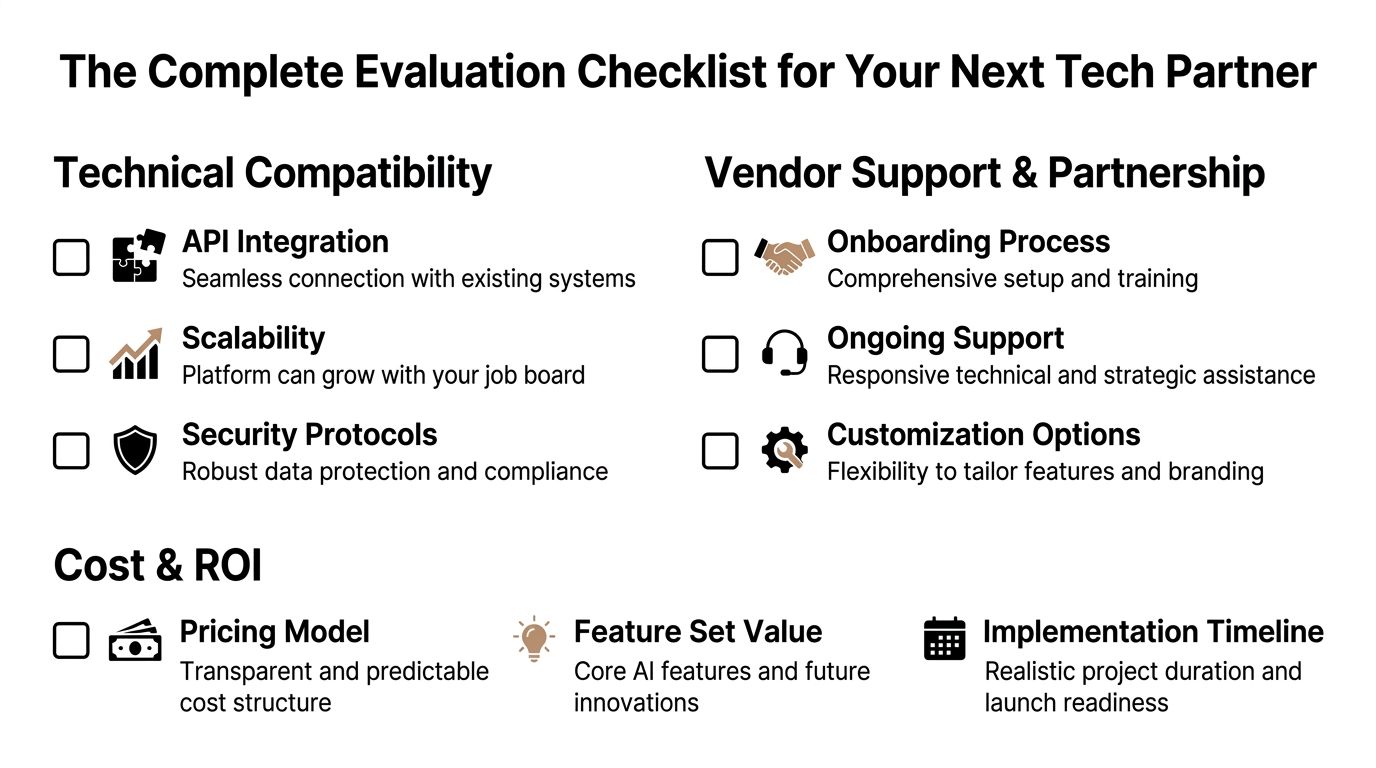
The Complete Evaluation Checklist for Your Next Tech Partner
Most bad platform decisions don’t fail because the demo was weak. They fail because the buyer didn’t press hard enough on the parts that only show up after launch.
A vendor can present polished screens and still be a poor fit for your board. The right way to evaluate a white-label partner is to inspect the system from three angles: matching quality, operational fit, and commercial reality.
Check whether the AI is useful
A lot of vendors still rely on dressed-up keyword logic. That creates brittle search and weak recommendations.
Top-tier white-label platforms use AI-powered semantic matching to achieve 85-92% accuracy, outperform older keyword-based systems by 30-40%, and increase application completion rates by up to 25% through better personalization, according to this industry review of white-label job board software.
That sounds technical, but the practical analogy is simple. Keyword matching acts like a clerk checking exact words on two forms. Semantic matching acts more like a recruiter who understands that related skills and similar phrasing can still signal a good fit.
Questions to ask the vendor
- How is matching performed. Ask whether the system uses semantic matching or keyword rules.
- What inputs drive recommendations. Resume, job description, profile behavior, or all of them.
- Can the model handle messy real-world data. Titles, synonyms, missing fields, and nonstandard resumes matter.
- How are false positives controlled. A high match score is useless if poor candidates flood the shortlist.
Red flag
If a vendor can only explain matching in marketing language, assume the underlying logic is shallow.
Inspect integration depth before you sign
An AI platform doesn’t live in isolation. It has to work with your board, your CRM, your ATS, your billing setup, your analytics, and your user identity layer.
Many projects often break down here. The feature exists, but users hit login friction, duplicate profiles, or awkward redirects that make the experience feel outsourced.
What good integration looks like
| Area | Good sign | Red flag |
|—|—|
| Authentication | Smooth single sign-on or low-friction account linking | Separate account creation with clunky handoff |
| Data flow | User actions and profile updates sync reliably | Manual exports or CSV dependency |
| Branding | Native-feeling domain and design continuity | Obvious third-party UI mismatch |
| Analytics | Events can be tracked across the full funnel | Black box reporting only |
If the board already serves students, graduates, or career changers, look closely at how the AI resume workflow fits the current journey. A tool such as a career platform white-label AI resume builder is useful to review because it shows how resume generation can sit inside a broader board experience rather than acting as an isolated page.
Review security and compliance like an operator
Security reviews often happen too late. That’s a mistake.
Your board handles personal data, resumes, work history, and potentially sensitive candidate information. If the AI vendor can’t explain where data flows, how access is controlled, and how compliance is handled, the commercial upside won’t matter for long.
Look for clarity on these points:
- Data boundaries between your board and the vendor
- Retention policies for resumes, generated content, and logs
- Administrative controls for support access
- Regional compliance posture if you operate across the US and Europe
Buy the platform as if your legal team will read the contract after the invoice is paid, because they probably will.
Understand pricing beyond the entry plan
Cheap entry pricing can be real value. It can also hide future friction.
What matters isn’t just the monthly fee. It’s how pricing scales with usage, branding needs, support, and revenue model. Some boards prefer predictable SaaS pricing. Others are comfortable with usage-based or revenue-share structures if the vendor is contributing meaningful product depth.
Ask these questions in writing:
- What triggers additional cost
- What support is included
- Are premium integrations extra
- Does pricing change by tenant, geography, or user volume
- Who owns the customer relationship and billing experience
Treat support as part of the product
A white-label partner is not a software download. It’s an operating relationship.
The launch may go smoothly, then a feed breaks, a login issue appears, or users get confused by one step in the workflow. Your users won’t blame the vendor. They’ll blame your brand.
That’s why support quality matters as much as feature quality.
Vendor support checklist
- Onboarding depth. Is setup guided or self-serve only?
- Issue ownership. Will they troubleshoot with your team or just point to documentation?
- Roadmap honesty. Do they distinguish current features from future promises?
- Service commitments. Are response expectations clear?
The best vendor is rarely the one with the flashiest homepage. It’s the one whose product works under real traffic and whose team behaves like a partner once the contract is signed.
A Step-by-Step Guide to Implementation and Launch
A strong vendor won’t save a messy rollout. Implementation succeeds when the board treats it like a product launch, not a code install.
The most reliable approach is phased. That keeps technical work, design work, and adoption planning from colliding at the last minute.

Phase one starts with plumbing, not polish
Connect the basics first. Authentication, profile data, job data, event tracking, and billing logic need to work before anyone debates button color.
This phase usually includes:
- Single sign-on planning so users don’t feel pushed into a separate product
- Profile and resume sync so candidate data doesn’t need to be re-entered
- Job feed alignment to ensure AI tools reference current listings
- Analytics setup for activation, usage, and conversion events
A practical mistake here is integrating only what’s easy. If the user has to upload the same resume twice or maintain separate profiles, adoption drops fast.
Branding should feel native, not decorated
White label works when users forget they entered a partner-powered workflow.
That means more than adding a logo. It includes typography, page transitions, navigation consistency, support language, and domain structure. If your board feels editorial and the AI experience feels like enterprise software from another company, trust drops.
What to align before launch
| Elemento | What to check |
|---|---|
| Visual identity | Logo, colors, fonts, spacing |
| Voice and copy | Instructions, empty states, tooltips, error text |
| Navigation | Where users enter and exit the AI workflow |
| Mobile behavior | Resume editing and application prep on small screens |
Operator note: The user doesn’t care whether the stack is modular. They care whether the experience feels continuous.
User journey mapping is where many boards either win or waste the rollout
The question isn’t just “Do we have AI features?” It’s “Where do users encounter them?”
Good placement follows user intent. Put the right tool at the moment of friction.
Esempi:
- A user views a job. Show match analysis and a resume tailoring prompt.
- A user saves a job. Offer interview prep and application tracking next.
- A returning user opens the dashboard. Surface unfinished actions instead of generic promotion.
Practical launch guidance can help here. If you want a simple example of staged deployment thinking, this walkthrough on how to launch a university AI career platform in 7 steps is useful because it shows how sequencing affects adoption.
Test with real users before full release
Internal QA catches broken links. It rarely catches confusion.
You need a small user group that reflects your audience. Include active job seekers, less technical users, and at least a few people who apply at volume. Ask them to complete realistic tasks, not just click around.
Good test prompts include:
- Find a relevant job and tailor your resume
- Generate a cover letter for that role
- Save the application and return later
- Track the job in the dashboard
- Explain what felt unclear
After you’ve mapped the rollout, a visual walkthrough can help your team align around what users will see and do.
Roll out in waves, not one big switch
A phased release gives you room to fix messaging, UX issues, and support workflows before the full audience arrives.
A practical launch sequence often looks like this:
- Soft launch to a limited group
- Staff-assisted period where support captures issues quickly
- Homepage and email promotion after friction points are reduced
- Monetization activation once the value proposition is clear
Launching before onboarding is ready is like opening a new terminal in an airport with no signs. The infrastructure may work, but people still get lost.
The boards that get the most value aren’t always the fastest to install. They’re the ones that make the new workflow feel obvious.
Go-to-Market and Monetization Strategies for New AI Features
A board launches AI resume tailoring, cover letters, and match scoring. Usage spikes in week one. Revenue does not. The usual reason is simple. The product shipped, but the business model did not.
Once AI enters the product, the board is no longer selling only listings or employer access. It is selling faster applications to candidates, better-qualified pipelines to employers, and branded career infrastructure to schools, associations, and training providers. That is a product expansion, but it is also a business model change.

Start with the revenue design
Boards often price AI as an add-on because that feels low risk. In practice, that can undersell the value and confuse buyers. A stronger approach is to decide first what new revenue line you are building. Candidate subscription revenue, employer upsells, institutional licensing, or a mix of the three.
This framing changes procurement decisions. A white-label platform is not just a cheaper way to add features. It can replace custom build work, shorten time to market, and give the board new inventory to package. Vendor stability matters here, because if AI becomes part of a paid offer, uptime, support response, and issue handling affect revenue directly. Review the vendor's service level agreement for white-label AI operations before you commit to pricing around it.
Four monetization models that map to different board economics
Freemium for audience activation
This model fits broad-audience boards, graduate portals, and communities where traffic is healthy but willingness to pay is unproven.
Give users one clear free win. Resume tailoring for one role is usually enough. After that, charge for repeated use, saved versions, deeper match analysis, or application tracking. The trade-off is support load. Free users create volume, so onboarding and upgrade prompts need to do real work.
Best fit:
- High-traffic boards
- Student and graduate audiences
- Boards with fast registration flows
Subscriptions for repeat-use candidates
Candidates who apply often do not want to purchase one tool at a time. They want a system that reduces effort across the whole search.
A practical packaging structure:
- Basic for limited tailoring or match checks
- Pro for unlimited documents, tracking, and stronger workflows
- Career bundle for interview prep and ongoing application support
This model usually produces better retention than one-off credits, but only if the workflow gives users a reason to return weekly.
Employer-side premium products
Employer monetization works best on boards where relevance matters more than raw applicant volume. Niche boards often do well here.
Useful offers include:
- Access to better-structured candidate profiles
- Shortlists ranked by fit or readiness
- Sponsored visibility inside high-intent candidate workflows
The risk is trust. If scoring feels opaque or biased, employers question quality and candidates question fairness. Keep the value proposition tied to workflow efficiency, not black-box promises.
B2B licensing to institutions
This is the model many operators miss. Universities, workforce programs, associations, and training providers often want career tools under their own brand, but they do not want to fund a full software build.
That turns the board into a platform business. Revenue comes from contracts, seats, or annual licenses instead of waiting for each candidate to convert one by one. For some boards, this becomes the highest-margin path because distribution is built into the institution.
Position the launch around outcomes people will pay for
Users rarely buy "AI." They buy shorter application time, clearer next steps, and less repeated work.
Strong messaging:
- Tailor your resume to each role without starting over
- See your fit before you spend time applying
- Prepare for interviews in the same place you track applications
- Keep every application organized in one dashboard
Weak messaging usually sounds impressive in internal meetings and underperforms in the market. Terms like advanced intelligence, transformation, or automation-first workflow do not explain why a user should pay this month.
Distribution decides whether monetization has a chance
Pricing matters, but distribution usually determines whether the new product line gets enough volume to matter.
Use channels you already control:
| Canale | What to sell |
|---|---|
| A specific use case, first success, then the upgrade | |
| In-product prompts | Timed upsells after a candidate gets value |
| Employer sales | Better pipeline quality and reduced screening time |
| Institutional outreach | Branded career services without internal development |
Partnerships can widen reach without forcing the board to build a large acquisition team. If that channel is part of the plan, this guide on how to accelerate growth with an affiliate program that scales your SaaS offers a practical model for extending distribution.
Keep the offer simple. Each audience segment should see one obvious paid next step.
One platform offering this type of setup is JobWinner. It provides white-label candidate tools such as resume tailoring, cover letter generation, interview prep, job match analysis, and application tracking under the board's brand. That matters if the goal is to build a new revenue line from an existing audience rather than bolt on isolated AI features with no clear path to monetization.
Measuring Success and Avoiding Common Integration Pitfalls
The first mistake boards make after launch is tracking the wrong wins. They celebrate feature release, email clicks, or demo interest. Those are useful signals, but they don’t tell you whether the new product line is working.
Measure behavior that reflects value created and value captured.
Track the KPIs that reveal whether the product is sticky
A practical KPI set usually includes:
Feature adoption rate
Are registered users trying the AI tools?Repeat usage
Do users come back to tailor another application, review another match, or continue tracking?Application progression
Are users moving from browsing to preparing and submitting?Net new revenue
Are AI features creating paid upgrades, stronger employer packages, or institution sales?Support burden
Are users succeeding smoothly, or does every activation create a support ticket?
The goal is simple. Tie product usage to either retention or revenue. If you can’t do that, the tool may be interesting but not strategic.
Candidate experience claims are easy. Compliance failures are expensive
Vendors often sell ease, speed, and better user experience. That’s fine. But the harder operational issue is privacy and compliance.
While vendors promise a 90% better candidate experience, 65% of boards in the US/EU cite privacy as a top barrier, and ignoring that can undermine ROI and expose operators to significant fines under regulations such as the EU AI Act according to AgileSoftLabs’ discussion of recruitment platform barriers.
That’s the kind of issue many teams postpone until legal review. By then, the product may already be embedded in key workflows.
What to check after launch
| Risk area | What to verify |
|---|---|
| Consent flows | Users understand what data is used and why |
| Data retention | Old resumes, generated content, and logs aren’t stored indefinitely |
| Vendor obligations | Responsibilities are clear in the agreement |
| Support access | Internal and vendor teams only see what they need |
If you’re evaluating the operational side of that relationship, review the vendor’s service-level agreement before expansion. It’s one of the clearest places to see whether support, uptime expectations, and issue handling are mature enough for a branded deployment.
Common mistakes that reduce ROI
Buying on price alone
Low monthly cost can look attractive. But if support is weak, integration is shallow, or users don’t adopt the workflow, the cheap option becomes expensive fast.
Launching without onboarding
A good product still needs guidance. Tooltips, first-use prompts, sample outputs, and short activation emails matter. If users don’t understand when to use the tools, many won’t come back.
Burying the feature in navigation
If the AI tools live on a hidden tab, usage will be low. The highest-performing placements usually sit near moments of intent, such as job detail pages, saved jobs, and application dashboards.
Treating vendor support as optional
When something breaks, your users won’t separate your team from the partner. If support paths are vague, your brand absorbs the damage.
The post-launch phase is where white-label decisions become visible. Before launch, you’re buying promises. After launch, you’re operating consequences.
What good looks like six months later
You should be able to answer a few hard questions clearly:
- Which user segments adopted the tools fastest
- Which feature leads to repeat visits
- What revenue stream showed up first
- Where users still drop off
- Which compliance process still needs tightening
Boards that can answer those questions tend to keep improving. Boards that can’t usually end up with an expensive feature set that looked strategic in the roadmap and peripheral in user behavior.
A white label ai platform for job boards pays off when it’s treated like a business extension. It fails when it’s treated like a decorative AI layer.
If you’re weighing that shift now, Vincitore di lavoro is one option to review for turning a traditional job board into a branded AI career platform with monetizable candidate tools. The key decision isn’t whether AI belongs on your board. It’s whether you want to own more of the candidate journey, or keep sending that value somewhere else.