 ES
ES  EN
EN  IT
IT  FR
FR 
When you're aiming to land an interview, your resume is your opening act. So, what's the best way to grab a recruiter's attention? For most job seekers in 2026, the hybrid resume is hands-down the best format. It strategically blends the best features of the chronological and functional formats, opening with a hard-hitting skills section before diving into a detailed work history. This one-two punch is perfect for grabbing a recruiter's attention and satisfying Applicant Tracking Systems (ATS).
What's the Best Resume Format for Recruiters?
Choosing a resume format is more than just a matter of aesthetics; it's the first strategic decision you make in telling your career story. Imagine this: a recruiter opens your resume. You have about 7,4 segundos to make an impression. That's it. Your layout has to make it incredibly easy for them to find the answer to one simple question: "Is this person qualified?"
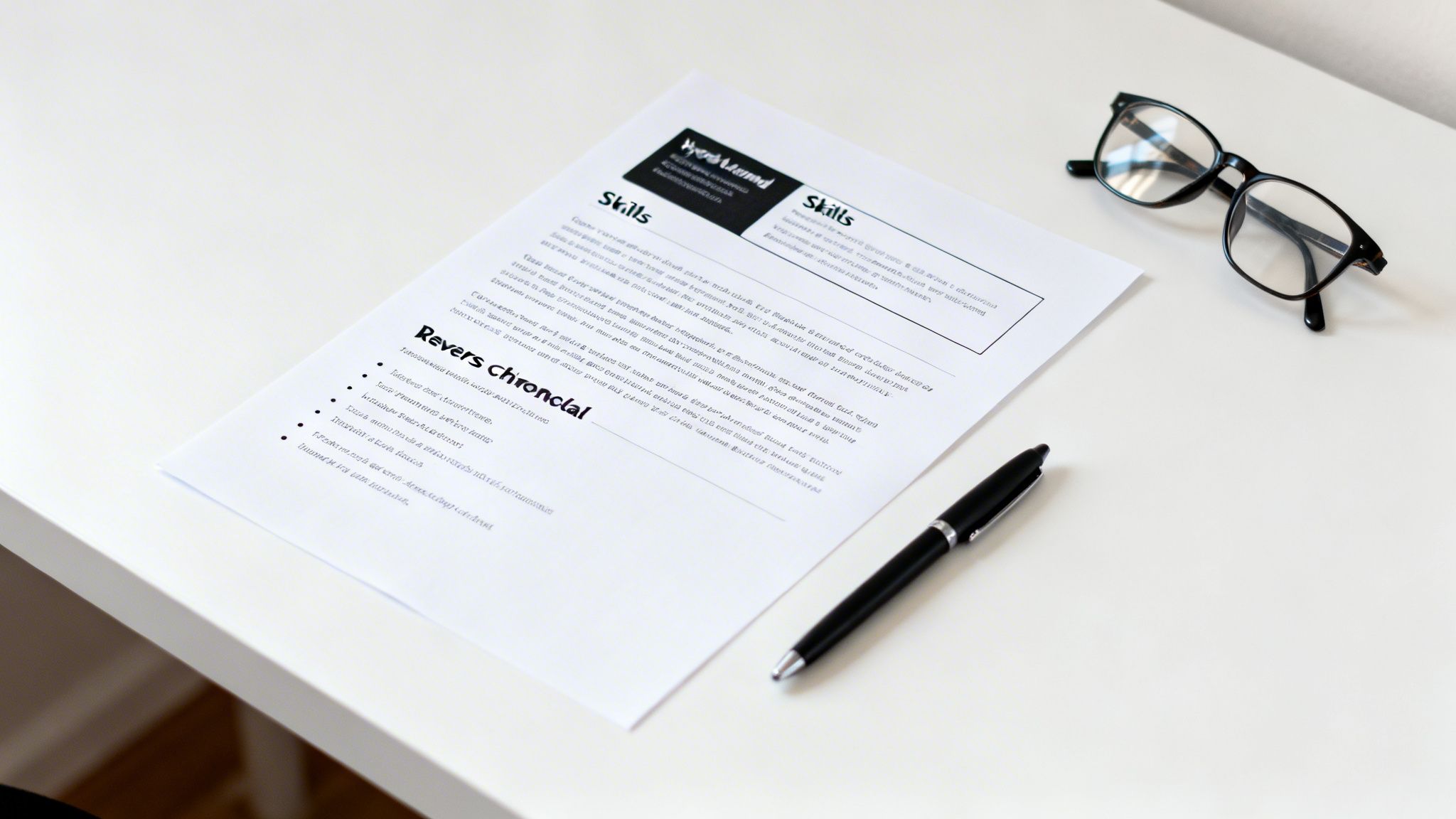
While you'll see a lot of variations out there, resume formats really boil down to three core types. Let's get to know them so you can pick the one that tells your story best.
The Three Core Resume Formats
Getting a handle on the pros and cons of each format is the first step to building a resume that actually gets you noticed. Let's break them down.
- Reverse-Chronological: This is the classic format everyone knows. It lists your work experience from your most recent job to your oldest.
- Pro: It’s fantastic for showcasing a clear, upward career progression.
- Con: It can unfortunately draw attention to any employment gaps.
- Functional (Skills-Based): This format puts your skills and abilities front and center, downplaying your chronological work history.
- Pro: It can highlight your abilities if you're making a major career change.
- Con: Recruiters often see it as a red flag, and it tends to perform poorly with ATS software.
- Hybrid (Combination): Here you get the best of both worlds. It kicks off with a prominent skills summary to prove your qualifications right away, then follows up with a standard reverse-chronological work history to provide context. In today's hiring world, this is the best resume format for recruiters in almost any scenario.
To help you see how they stack up, the table below gives a quick overview of each format's strengths and weaknesses.
Resume Format Quick Comparison Guide
This side-by-side comparison breaks down the three primary resume formats, evaluating how well they work for recruiters, applicant tracking systems, and various career levels.
| Tipo de formato | Mejor para | Recruiter Preference | Compatibilidad con ATS |
|---|---|---|---|
| Hybrid | Most professionals, career changers, skilled workers. | Alto | Alto |
| Cronológico | Professionals with a steady, linear career path. | Alto | Alto |
| Funcional | Risky; sometimes used for major career pivots or gaps. | Bajo | Bajo |
As you can see, the hybrid format is the clear winner, scoring high marks for both human recruiters and ATS bots. It simply gives everyone what they need. While the traditional chronological format remains a solid option, you can explore its specific applications in our guide on the currículum en orden cronológico inverso. The functional format, on the other hand, is a gamble that rarely pays off.
Why the Hybrid Resume Format Is So Effective

There’s a good reason the hybrid resume has become the go-to format for savvy job seekers. It’s built to win in the modern hiring game, where you have just seconds to make your case. With recruiters spending an average of only 7,4 segundos scanning each resume, first impressions are everything.
The hybrid format nails that first impression by putting your most compelling qualifications front and center. It leads with a powerful summary and a dedicated skills section, immediately answering the recruiter's biggest question: "Does this person have what it takes?" This strategic, "skills-first" approach shows them you're a match before they even get to your work history.
The Double Win: Acing Both ATS and Human Scans
A modern resume has to pass two tests: the robot and the human. The hybrid format is masterfully designed to impress both, which is why it's the best resume format for recruiters and the Applicant Tracking Systems (ATS) they rely on.
For the ATS, that prime real estate at the top—your summary and skills sections—is the perfect place to pack in keywords from the job description. This is how you boost your match score and get past the initial screen. Then, for the human recruiter, the familiar reverse-chronological work history follows, providing the clear context they need to see your career path and verify your achievements. It's a true win-win.
Think of it this way: The hybrid format avoids the common pitfalls of the older functional resume. By combining a keyword-rich skills section with a standard chronological history, you give the ATS the data it wants while giving the recruiter the clear, trustworthy story they need.
A Format Built for a Skills-First World
The hiring landscape has changed for good. Companies are no longer just looking at job titles or years on the job; they're hiring for proven skills. This isn't just a trend—it’s how hiring is done now.
In 2026, skills-based hiring is the dominant practice. We're seeing 43% de empresas officially prioritize it, and 70% de reclutadores say their main challenge is simply identifying the right skills in a candidate. The hybrid format directly solves this problem by showcasing your capabilities right from the start. It’s no surprise this format gets more callbacks, and you can see more data on why this resume format will dominate by reviewing the latest findings on resume trends.
This shift means the hybrid format is more than a choice; it's a strategic tool. It frames your value around what you can hacer, which is exactly what employers want to know.
Of course, using the right format is only half the battle. To learn what to put in each section for maximum impact, check out our deep dive into the key componentes de un currículum moderno.
Here’s a quick comparison that shows exactly why the hybrid is a huge improvement over the functional format it evolved from.
| Comparación de características | Functional Resume | Hybrid Resume |
|---|---|---|
| Recruiter Trust | Low (Often hides gaps) | Alto (Skills are backed by experience) |
| ATS Performance | Poor (Unusual structure causes errors) | Excelente (Standard sections are easily parsed) |
| Storytelling | Confusing (Skills are disconnected) | Clear (Shows skill application over time) |
Ultimately, the hybrid resume isn't just a layout. It’s a communication device engineered for how companies hire today, presenting your story in a way that’s fast, clear, and effective for both software and people.
How to Build a Winning Hybrid Resume
Alright, you understand por qué the hybrid resume format is so effective. Now, let's get into the nitty-gritty of building one. Putting together a strong hybrid resume is a strategic process—every section has a specific job to do. I'll walk you through how to construct each part to make the biggest impact.
The real power of a hybrid resume lies in its structure. It intentionally puts your most compelling qualifications right at the top, immediately grabbing a recruiter's attention, before backing those claims up with a detailed work history.
Core Components of a Hybrid Resume
A well-crafted hybrid resume follows a specific order designed to tell your professional story in the most persuasive way. You're essentially starting with the conclusion—"I'm the right person for this job"—and then laying out the evidence.
Here are the essential sections, in the order they should appear:
- Información del contacto: Keep it clean, professional, and easy to find.
- Resumen profesional: Your 3-4 line "elevator pitch," customized for the specific role.
- Core Competencies / Skills Section: A keyword-heavy list of your most relevant skills.
- Professional Experience: Your work history in reverse-chronological order, focused on achievements.
- Educación: Degrees, certifications, and other relevant academic credentials.
- Optional Sections: Things like personal projects, publications, or volunteer experience can be added here if they strengthen your case.
From Good to Great: The Professional Experience Section
This is where you prove the claims you made in your summary and skills list. It’s easy to just list job duties, but the best resume format for recruiters is one that turns those duties into quantifiable achievements. Let's break down the difference.
A "good" bullet point just says what you did. A "great" one shows the impact of what you did, using hard numbers and tangible results.
Here’s how to transform your experience from just descriptive to truly compelling.
| Before (Good) | After (Great) | Por qué funciona |
|---|---|---|
| Cuentas de redes sociales administradas. | Grew organic social media engagement by 45% across 3 platforms in 6 months. | It quantifies success with a clear metric (45%) and a defined timeframe. |
| Responsible for team projects. | Led 5 cross-functional projects with a $500K total budget, delivering all 15% ahead of schedule. | It adds scope (budget) and efficiency (schedule) to demonstrate leadership and results. |
| Helped improve sales. | Implemented a new CRM workflow that contributed to a 20% increase in qualified leads. | It connects a specific action (new workflow) directly to a valuable business outcome. |
See the pattern? The "Great" examples are built on action verbs and metrics. This is the language hiring managers speak. They don’t have time to guess your value; you need to spell it out for them.
Optimizing Your Skills Section
Your Skills or Core Competencies section is your best friend when it comes to applicant tracking systems (ATS). Don't just dump a list of words there. Instead, group your skills into logical categories. This simple tweak makes your qualifications much easier for a human recruiter to scan and understand in that initial 7-second glance.
A Good Skills Section:
- SEO, Content Marketing, Google Analytics, Email Marketing, Social Media, SEM, A/B Testing, WordPress
A Great Skills Section:
- Marketing digital: SEO, SEM, Content Strategy, Email Marketing, Social Media Management
- Analytics & Tools: Google Analytics, A/B Testing, SEMrush, HubSpot
- Habilidades técnicas: WordPress, Basic HTML/CSS
This categorized layout shows you’re organized and helps a hiring manager instantly see that you have the specific mix of skills they need. To get a head start, check out some of the Las mejores plantillas de currículum gratuitas that already have these smart, structural elements built-in. Every detail in how you present your information is an opportunity to make a stronger impression.
Choosing the Right Resume Format for Your Career
While the hybrid resume is a fantastic all-rounder, the best resume format is the one that tells su story most effectively. Think of it like this: you wouldn't use a hammer to turn a screw. Your experience level, industry, and the job you're targeting all dictate which format will get you the best results.
Let’s walk through the common scenarios to figure out which format is the right tool for you. We’ll look at when to stick with the classics and which layouts are just too risky.
When the Chronological Resume Is Still King
Don't write off the reverse-chronological resume just yet. It’s not outdated; it’s a specialist. Its strength lies in showcasing a clear, upward career trajectory. In some cases, it's not just a good choice—it's the only one hiring managers want to see.
You should seriously consider a chronological resume if you are a:
- Seasoned Executive: For senior leaders with a long, impressive track record, this format is the gold standard. It highlights a powerful career progression that C-suite recruiters expect.
- Professional in a Conservative Field: Industries like law, finance, government, and academia value tradition. A chronological resume shows you understand the norms and presents your work history in a way they can easily digest.
- Expert with a Linear Career: If you've spent your entire career in one field, moving up the ladder step-by-step, this format is your best friend. It lets that clear progression speak for itself.
Example: A Seasoned Executive
A Chief Financial Officer with 20+ years of experience would use a chronological resume to map their journey from Financial Analyst to Director of Finance, and finally to CFO. Each role logically builds on the last, and the progression itself becomes compelling proof of their expertise.
This flowchart can give you a quick visual to help you decide.
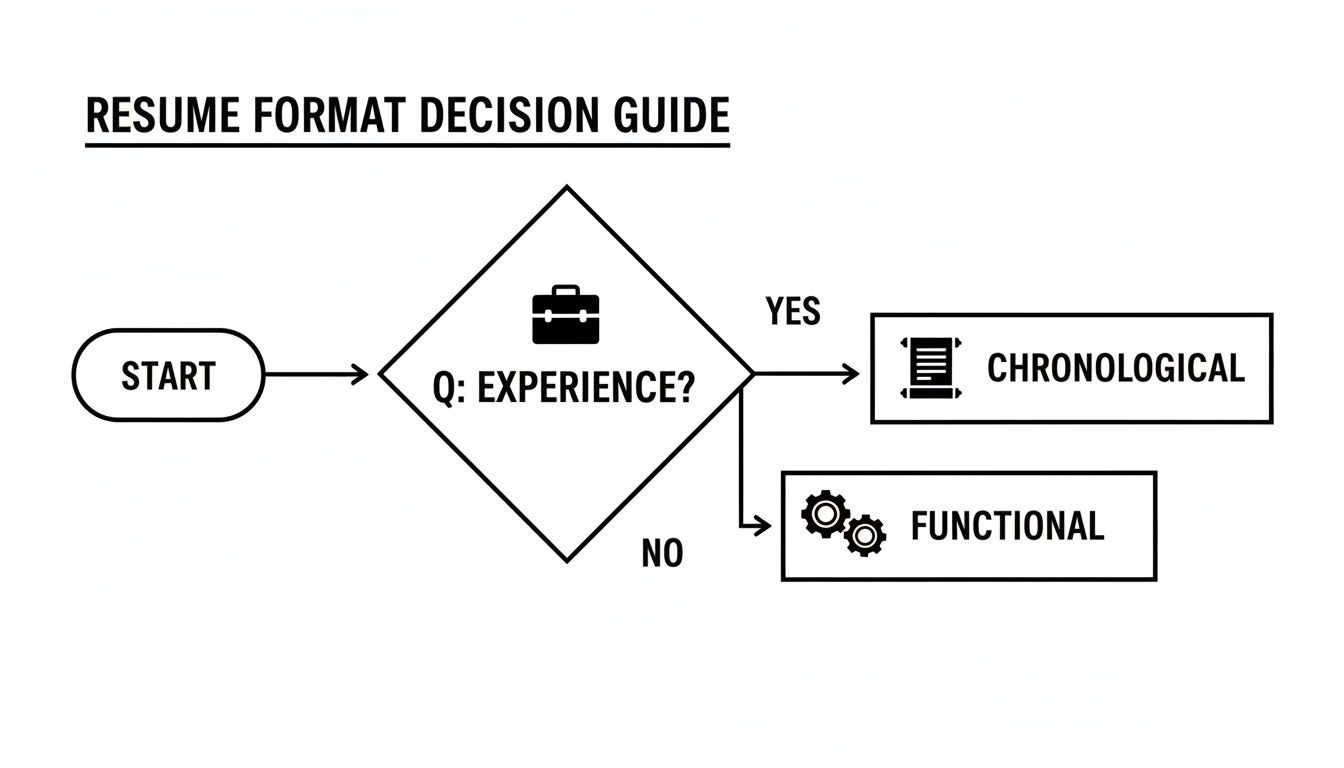
As you can see, a straightforward work history usually points toward the trusted chronological format. It's when your path isn't so linear that other options might seem tempting.
The Functional Resume: A Risky Bet
On paper, the functional resume—which groups experience by skill rather than by job—seems like a perfect solution for career changers or people with employment gaps. It lets you highlight what you can do. The problem? In the real world, it’s a gamble that almost never pays off.
Frankly, most recruiters are immediately suspicious of them. Their first thought is, "What are they trying to hide?" Beyond that, Applicant Tracking Systems (ATS) are built to parse chronological histories. The unusual structure of a functional resume often confuses the software, getting your application tossed before a person even lays eyes on it.
Key Reasons to Avoid the Functional Format:
- It Raises Red Flags: Recruiters automatically assume you have something to hide, whether it's major employment gaps, a history of job-hopping, or a lack of relevant experience.
- Poor ATS Performance: Most resume-scanning software will struggle to make sense of a resume without a clear timeline. This can lead to a low match score or an automatic rejection.
- Lacks Credibility: Skills listed without the context of where you used them just don't carry the same weight. The hybrid format solves this problem by directly connecting your skills to specific achievements in your work history.
Choosing Your Format Based on Career Scenarios
To put it all together, let's look at how your personal situation should guide your choice. Context is everything.
| Your Situation | Recommended Format | Por qué funciona |
|---|---|---|
| Cambio de carrera | Hybrid | Lets you spotlight transferable skills at the top while still providing the standard work history that both recruiters and the ATS expect to see. |
| Recién graduado | Hybrid | Puts your relevant skills, projects, and internships front and center, compensating for a shorter full-time work history. |
| Steady Career Path | Cronológico | Perfectly showcases a clear, impressive, and easy-to-follow story of upward career mobility. |
Choosing the right format is the foundation of a strong application. Once you have the structure down, the next step is tailoring the content. For a closer look at that process, check out our guide on why industry-specific resumes win jobs. Your resume's layout and its content should work together to make the best possible case for you.
Getting Your Resume Past the Bots—And Into Human Hands
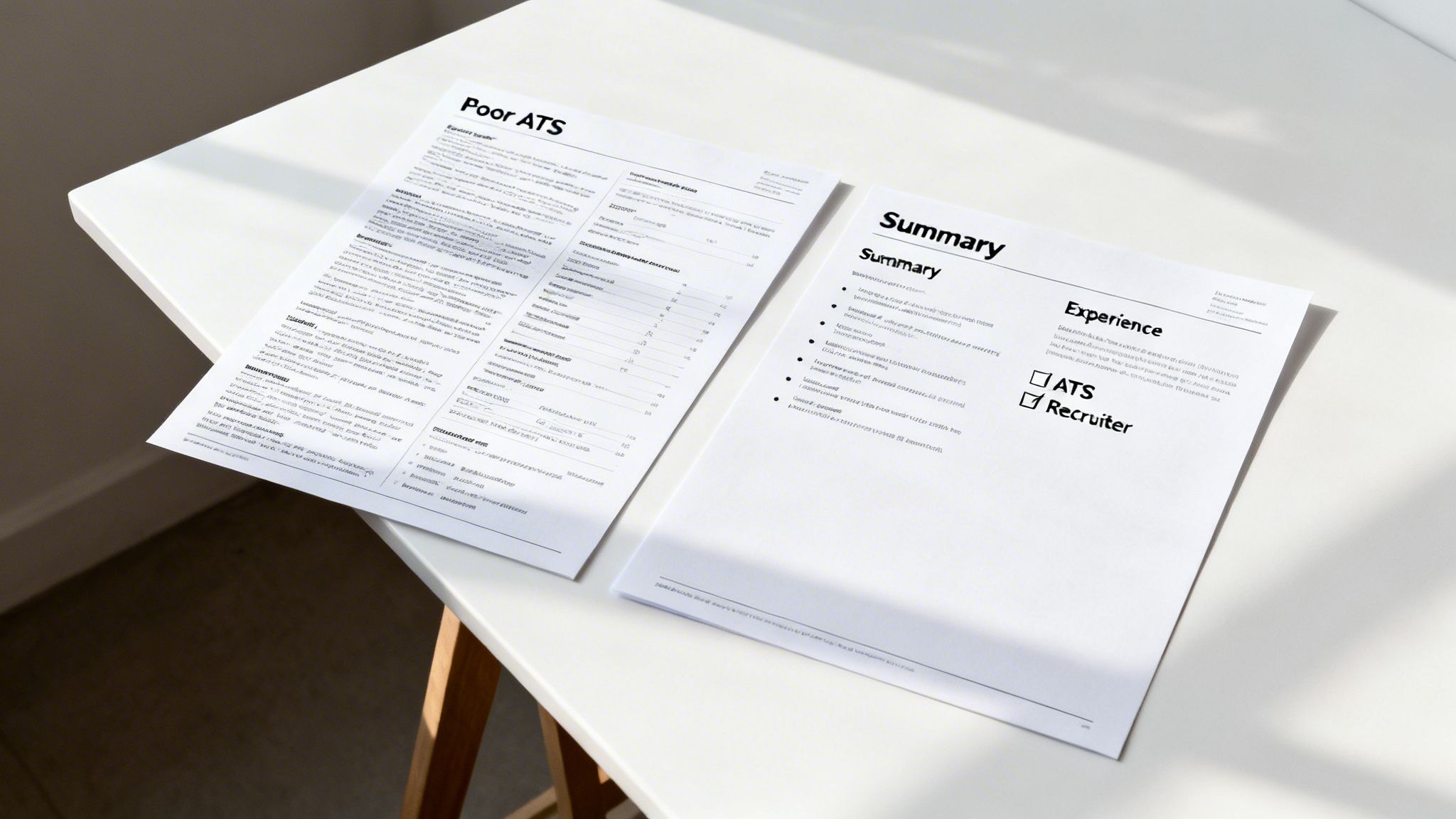
Every time you apply for a job, your resume faces a two-part challenge. First, it has to get past the Applicant Tracking System (ATS)—the software most companies use to filter applications. Only then does it land in front of a human recruiter, who will give it a mere seconds-long glance.
Think of it this way: you can't impress the recruiter if the software has already screened you out. This means your resume must be built for both a machine and a person, blending technical compliance with a compelling, easy-to-read story.
Getting Past the First Gatekeeper: The ATS
Let’s start with the first hurdle. With over 90% of large companies using an ATS, you have to assume your resume will be scanned by software before a person ever sees it. These systems are powerful but not very sophisticated; they are designed to parse simple text, and they get confused by anything fancy.
If an ATS can't read your resume correctly, it's the same as if you never applied. To avoid getting tossed into the digital void, you need to play by the software's rules.
- Stick to Standard Section Titles. Don't get creative here. Use clear, conventional headings like “Work Experience,” “Education,” and “Skills.” A quirky title like “Where I’ve Been” will just confuse the parser.
- Use a Clean, Simple Font. Stick with universally recognized fonts like Arial, Calibri, or Times New Roman. Scripted or custom fonts might look nice, but they can be unreadable to the software.
- Ditch the Fancy Formatting. This is where most people go wrong. Absolutely no tables, columns, text boxes, headers, or footers. These design elements break the parsing software, causing it to scramble or completely ignore the information inside them. A clean, single-column layout is always the safest bet.
- Choose the Right File Type. When you have the option, a .docx file is often the most compatible choice. While PDFs are great for preserving your layout for human eyes, some older ATS versions can struggle with them. If the job posting doesn't specify, a Word doc is a safe default.
I’ve seen countless fantastic candidates get rejected simply because they submitted a beautifully designed resume that the ATS couldn’t decipher. A single text box or graphic element can be enough to get you disqualified automatically.
Making the Cut with the Recruiter
Once you're past the bot, your resume has about 7 segundos to grab a recruiter’s attention. This is where your focus shifts from technical compliance to human psychology. Recruiters are scanning for one thing: evidence that you can deliver results.
Your job is to make that evidence as clear and impactful as possible.
Make It Easy to Scan
A wall of text is an instant turn-off. Recruiters are busy, and they appreciate a resume that's easy to skim.
- Embrace White Space. Don't cram everything onto one page. Use comfortable margins (around 1 inch) and leave blank lines between sections. This makes the document feel organized and approachable.
- Use Bullet Points for Achievements. Ditch the long, narrative paragraphs under each job. Instead, use bullet points to highlight your key accomplishments. It’s the perfect format for a quick scan.
- Lead with Strong Action Verbs. Start every bullet point with a powerful verb. Instead of "was responsible for," write "Managed," "Grew," "Launched," or "Reduced."
For a deeper look at getting this right, check out our complete guide on building an Formato de currículum compatible con ATS for more in-depth tips.
Numbers Tell the Strongest Story
The fastest way to show your value is with hard numbers. Quantifying your accomplishments provides concrete proof of your impact, turning a vague duty into a tangible success. It’s what separates a good resume from a great one.
Look at the difference a few numbers can make:
| Vague Description | Quantified Achievement |
|---|---|
| Cuentas de redes sociales administradas. | Grew organic social media engagement by 40% en 6 months. |
| Responsible for sales outreach. | Exceeded quarterly sales targets by 15%, generating $50k in new revenue. |
| Improved team workflow. | Implemented a new project management system that cut reporting time by 10 horas por semana. |
By mastering this two-pronged approach, you build a resume that satisfies the technical requirements of the ATS and delivers the persuasive punch needed to impress a recruiter. It’s how you give yourself the best shot at landing that interview.
Common Questions About Resume Formats
You’ve put in the hard work, picked a format, and built your resume. But even with a finished draft, a few last-minute questions can creep in and cause you to second-guess everything. That’s perfectly normal.
Let's clear up some of the most common things that trip people up so you can send off your application with total confidence.
How Long Should a Resume Be?
I get this question all the time. For most people, the gold standard is a single, powerful page. Sticking to one page forces you to be ruthless with your editing, ensuring that only your most impressive accomplishments make the cut. Recruiters are moving fast, and a concise resume almost always wins.
But what if you have a long and storied career? If you have more than a decade of directly relevant experience, or if you're in a field like academia, science, or senior management, a two-page resume is completely fine. Don't try to cram 15 years of experience onto one page.
In fact, a recent study found that 77% of hiring managers actually prefer a two-page resume for seasoned candidates. The key is that every single point on that second page has to earn its spot and be relevant to the job you want.
Should I Put a Photo on My Resume?
If you're applying for jobs in the United States, the answer is an emphatic No. Including a photo on your resume can introduce unconscious bias into the hiring process, and most U.S. companies have strict policies against it. Your resume might even get flagged and discarded by an automated system to avoid any hint of discrimination.
Of course, hiring norms change depending on where you are in the world. In many countries across Europe and Asia, for instance, a professional headshot is expected. If you're applying for a role internationally, always do a quick search on the local resume customs.
What File Format Is Best for Submitting My Resume?
This is a small detail that can have a big impact. A PDF is fantastic for locking in your formatting and making sure your resume looks exactly as you intended on any screen.
The catch? Some older Applicant Tracking Systems (ATS) can have trouble parsing the text from a PDF correctly. The absolute best practice is to read the application instructions carefully. If the job posting asks for a .docx file, send a .docx file. When they don't specify, a PDF is generally the modern, safe choice.
Here’s a quick summary of the most frequent questions:
| Pregunta | Short Answer | The Detail |
|---|---|---|
| Use a creative resume? | Be very careful. | Submit a clean, professional version for the ATS. Showcase your creative work by linking to an online portfolio. |
| One page or two? | One page for most. | Two pages are acceptable for 10+ years of highly relevant experience. |
| Include a photo? | No (in the US). | This is standard practice to prevent bias. |
| Best file format? | PDF (usually). | Always default to what the job ad asks for; some systems still prefer .docx. |
Ready to stop worrying about formats and start landing interviews? JobWinner's AI-powered tools build perfectly tailored, ATS-friendly resumes and cover letters in seconds. Let our technology handle the details so you can focus on acing the interview. Create your winning application with JobWinner today.